Showing posts with label food. Show all posts

Monday, 22 March 2010

The importance of being idle

SALTA, ARGENTINA - 22nd March 2010

Prior to this morning, the last time I had to wake myself up for something, without the backup of having someone else to wake me up anyway, was at 3am in Auckland Airport back on that epically long 1st February. Clearly, I'm out of practice with this whole waking up malarkey - a fact not helped by my mobile phone-cum-alarm getting smashed back in Queenstown.

Having met up the night before for a cheeky bite to eat, Tom and I had decided to get up e.doors and hike our way up to the 1500m summit of Cerro San Bernado - the hill overlooking the city. In order to avoid the savagery of the tropical heat beating down later in the day, we agreed to meet bright and early at 8.45am at the foot of the hill, by the statue of Martín Miguel de Güemes - a hero in this northwestern part of Argentina thanks to his role in defending the north-west against the Spanish in the Argentine War of Independence. However, an 8.45 meet-up was looking pretty grim when I awoke and looked at my watch to find hands pointing towards a quarter to 10!

Feeling like a prize dickhead, I headed pessimistically over to the Güemes monument anyway - I figured at some stage on my way up/his way down we'd have to cross paths and I could apologise for being useless. What a surprise it was then, as I paused to photograph Güemes in all his military glory (see right), that over from my right strolled young Thomas - turns out he, being an equally useless boy, had done very much the same thing and had only been waiting at Güemes' foot for a bit over 10 minutes!

So up we went - step by step ascending to the top of this striking hill in, thanks to our mutual ineptitude, far hotter and more uncomfortable conditions that we'd intended, but the time flew by. Whether from the refreshment of having someone new to talk to, or the liberation of being able to speak totally frankly again, or just the immature amusement that comes only from laddish chat, it barely seemed like we'd set off before we found ourselves sitting pretty, looking down on Salta and - obviously - backing the bid!


The stroll back down was, surprisingly enough, much faster, but having both largely skipped breakfast thanks to our waking up woes, we were both bloody starving by the time we were back at street level. Cue scouting out a speciality empanada restaurant and, being hungry, growing boys, ordering a solid round of 6 (or 8?) special local-style empanadas (potatoes, chillies, and beef), followed by a proper main course involving plenty of meat, followed by fruit salads - all washed down with the delicious Salta Negra malt beer. Then it was definitely time to chill out back at Las Rejas.

Some quality kotching included time for Tom to get an email from his Mum with details of a Salta restaurant that had featured in The Observer's travel supplement - one of only 3 South American restaurants to be featured. As the same place had been recommended by Taylor back in Mendoza, there was no questioning La Casona del Molino as our choice of dinner destination. Unfortunately, the place was a mission and a half from the city centre where we were and, after making the ill advised decision to walk, we discovered that we'd inadvertently and wholly unnecessarily walked a good 6 blocks further north than we needed to, so proceeded to cover the same ground again back south. All in all, we walked the best part of 35 blocks before finally arriving, and very quickly realised that it was very much closed. Monday. Closed Day. Not cool.

Now knowing not to make the same error of heading north/south, our walk back home in a straight eastward direction was hella shorter (probably still 25 blocks though), and with hunger and time nipping at our heels we found ourselves in Plaza 9 de Julio (Iglesia Catedral looking stunning in its lit-up state, below) and were sold by the classic, simple option of superpanchos (foot-long hot dogs) - which came complete with all ends of sauces and toppings. I got one topped with sweetcorn and one topped with something else; both were fantastic.


Well aware that last night's decision to book of 2 consecutive days of tours to cool places around the area obligated us to two consecutive morning departures of 6.30am, and conscious of our collective waking performance this morning, it is hardly a shock that tonight is an early night!

Saturday, 20 March 2010

Hot pools and colossal scrambled eggs

MENDOZA, ARGENTINA - 20th March 2010

After the wine, bike and and steak festivities of Thursday, we awoke yesterday to the greeting of grey skies and rain - prompting not-so-nostalgic references to England from all sides. There was the possibility of me joining Taylor, Tom and Nick early morning on a trip up to do a 45 metre abseil; a possibility that was suitably thrown out the window at the prospect of having to go outside and, God-forbid, get wet. Instead, Anna and I headed off at around lunchtime to the thermal pools located an hour or so out of town, armed with the bottle of Malbec we'd picked up at Bodega di Tomasso the previous day.


The bus ride took us about an hour out of town and up into the hills, with the hot spring located in a valley carved by centuries of river-driven erosion between two giant ridges. It was a good setup though - the site comprised of a series of pools of various sizes and shapes, gradually moving further and further down the hill and ultimately down to the river level at the bottom, where a large pool with a fountain in the middle (see above) is bordered by an artificial river and cold, cold water. The hot spring water arrived at the top-most pool, and arrived at a temperature so damn hot you simply could not touch it (if you did, you're first instinct is that it is cold - that was how hot it was). From there, however, it was allowed to cascade downward from pool to pool, gradually cooling all the way and thus giving us punters a selection of water temperatures to suit our preference at the time.

Punters were indeed there in abundance, both of the local Latin variety and in the form of Taylor, Tom and Nick (middle, bottom-right and bottom-left respectively in photo below), whose abseiling trip included a trip to the hot pools to chill out afterward. The 5 of us entertained ourselves for many an hour, finally parting on departure as their minibus left an hour before our local bus was scheduled to head off. Thanks to a beer and a plate full of empanadas though, the interim period was passed more than happily.


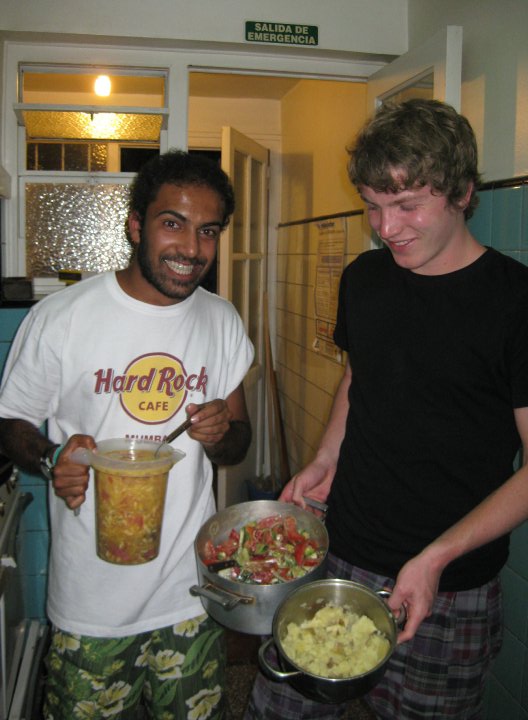
We were all reunited later back in Hostel Lao, and began putting into action what we'd been discussing earlier in the day with regards to dinner time. In particular, the need to spend less money (after the splurge on the best steak ever), the desire to do some cooking, and the general consensus on a massive omelette. A stroll to a supermarket and back enabled the acquisition of a cool dozen and a half eggs, several hundred grams of cheese, a good 10 rashers of bacon, a load of chorizo and an even bigger load of tomatoes, and fuelled with free-flowing vino (provided by the hostel!) set about a top drawer team effort of chopping, slicing, frying and generally operating like a well oiled machine and, ultimately, producing the most whopping great big concoction of omelette mix you'll ever see (as illustrated in my right hand in the photo to the right), alongside an equally impressive vessel of fresh salad.

It quickly became apparent that the sheer volume of omelette mix we were dealing with meant making an omelette was impossible, but a smooth-as-silk switch to scrambled egg in no way diminished the quite ridiculous amount of food we'd prepared for ourselves. However, while it would be fair to say that there was a lot more food than was necessarily needed to feed 5 people, it has to be borne in mind that some of us eat a lot more than others... so it goes without saying that half an hour later, everything was gone (save a nasty amount of dish washing).

Today though, we find ourselves in an interesting moment in our trip as - for the next few days - Anna and I are going are separate ways. As I continue the blast up north and head to Salta (to be accompanied a few hours later by Tom), Anna is taking advantage of geographical proximity to make a return trip to good old Buenos Aires. In theory, we'll meet again mid-week...

Wednesday, 17 March 2010

Valpy: the colourful slum

VALPARAÍSO, REGION V, CHILE - 17th March 2010

Self-proclaimed as the cultural capital of Chile, Valparaíso is definitely one of a kind. Walking around shortly after we arrived night-before-last, it was a city of shadows - cobbled streets lined with dilapidated buildings with walls of corregated iron, each hidden away in another pocket of darkness carved out among the imposing hills that rise eternally upward from the city's Pacific shoreline.

Thanks to LPG's proclamations that "the bohemian among us love it" and "the shutter happy simply tremble at the city's picturesque possibilities", Anna was well in love with the place long before we arrived at its messy bus terminal, and was duly gushing with bohemian (apparently) delight in the mish-mash mess of graffiti-clad walls, dirty streets, and passajes (alleyways) meandering dubious paths up the steep hills - not to mention the sense of being somewhere "so poetic". I don't really buy into pre-determination of places, and my first impressions were of a city that may be fairly cool, but objectively speaking had dog shit on every path every 5 metres, had drunks stumbling around dark alleys whose cobbled stones were lined with broken glass bottles and general trash, where the walls, shutters, statues or anything else were covered in crappy graffiti tags, and where very second street corner stank of human urine. It was 9pm, but in many ways it felt like 3am on a Friday night in one of the shadier areas of Bristol.

With aimless post-arrival wandering achieved, dinner was another excellent affair - SaborColor was scouted (being one of the few places in the vicinity of the hostel that was actaully open), and served up a delectable platter for two featuring pork ribs, beef in some excellent sauce, speciality empanadas and vegetable skewers; washed down (in my case) with the excellent local "cerveja artesanal" - Volcanes Bock. Happy stomach.

The following day (yesterday) was Valpy's* opportunity to prove itself (only to me, of course - Anna was already fronting the Valpo Cheerleaders brigade), and to be fair it has done a pretty good job. For sure, there's still shit of every street, and the multitude of cables that run above every road have about as much visual appeal as said shit, but there's no denying that this place is absolutely out of the ordinary. Ostensibly a port town, it thirived in the late 10th century as the leading port along the Cape Horn/Pacific shipping route, particularly as the Californian Gold Rush gathered steam. Valpy's steam was fairly spectacularly wiped out in 1906, however, when a whopping earthquake decimated the city, and salt was rubbed into the raw wounds 8 years later when those crafty lads up in Panama opened up their eponymous canal. Valpy remains a port town though, and we passed a hell of a long time down at Muelle Prat watching the busy working of the container terminal shipyard.

The real story in Valpy, however, is its artistic heart. Its building may be falling to pieces, but tens of thousands of multi-coloured facades make quite an impression when lined up one behind the other rising up a dramatic hillside; their dilapidation, if anything, adds to it. And the walls are definitely covered in graffiti, but whereas last night's soujourn offered prize views of the sor tof crappy "tags" that pollute railways lines across Europe, today offered a whole different world - phenomenal murals stretching across entire walls, between street furniture, and all combined in one place to form the Museo al Cielo Abierto - "open air museum". You have to take a step back and think about what is actually going on - you are on an average street in a city, surrounded by houses and residential buildings, and here all around you is an art gallery of the highest calibre - on the walls! It is mental - a sense compounded by the ever-present stunning view over the city as you are, as always, atop of a whopping big hill that just goes up and up and up...! Amazing.

From one art form to another, and a further walk up the hill brought us to La Sebastiana - one of the many houses of Chilean poet extraordinaire and Nobel Laureate Pablo Neruda. I've known of the guy since I was about 10, thanks to that good old source of all knowledge The Simpsons, but in the decade or so that has followed I'd be lying if I said I'd actually read a word of his work. Anna, on the other hand, has been known to cry when reading "Twenty Love Poems and a Song of Despair" - Neruda's most noted work; it doesn't take a genius to conclude that she was going into La Sebastiana without quite the same objectivity as your average pleb (in this case, yours truly).

Objectively speaking though, it's gotta be said that Neruda knew how to design a house. For sure, he was clearly a rich jerk with too much money for his own good, but he spent his money on some impressively cool crap. The house - perched on a hilltop - overlooks the whole of colourful Valpy below; the living room, decked with individually chosen chairs, tables, paintings of Kings and Queens and all sorts of other junk, offers a spectacular view out to the Pacific below and, as informed by the excellent audio tour provided, was the scene of annual New Year's Eve gatherings for the best possible view of Valpy's renowned fireworks display. Better still was upstairs - the bedroom offered the same view, but in incredible panorama from the expanse of Neruda's huge bed where he and his wife (one of several) spent their time. Best of all, the top floor study room - again offering the view, but with walls adorned with photos, drawings, all kinds of random crap and - my favourite thing in the whole house - a early sixteenth century map of the Americas, featuring "the island of California", totally missing the existence of Texas, and generally adding and subtracting various landforms at will. A great piece of stash.

Dinner that night was a fairly low key affair - it probably involved meat and beer - but definitely worth mentioning was lunch at "Royal J Cruz" - a fantastic little place hidden up a little alleyway off the main street in town. The food - a traditional chorrillana - consisted of a mahoosive plate piled with fries, covered in spicy pork, fried onions and egg (conservatively described in the LPG as "mountainous"), but of real note was the place itself: every piece of it, from walls to tables to tablecloths and windows, was covered in grafittied messages, photos of patrons, scribbles, doodles - anything and everything. I've never seen anything like it, and doubt I'll ever see the like again. Perhaps a photo of it will appear on this blog one day though...

Today we went out separate ways - as always I took the opportunity to walk and walk and walk and ended up atop of the western end of the Valpy hill at the Museo del Mar Lord Cochrane. Cochrane was a British naval general who helped the Chileans oust the Spaniards back in the day, and had a big role to play in capturing Valparaíso, so is generally loved in these parts (so much so that Neruda even stuck a painting of him up in La Sebastiana). Sadly, and in total contradiction to the opening hours posting on the wall outside the entrance, the museum was closed - but all was not lost as the courtyard offered the best views of Valpy I'd yet discovered, and also randomly met an English chap called Kevin who joined me on a bit of a trek over to Iglesia Matriz - the site of four churches since 1559. The most recent of them doesn't look like much on the outside, but inside it's as impressive a place as you'd care to see - full of colour and ornately decorated chapels and altars.

Time in Valpo is short, however, and tonight it's off back to Argentina on an overnight bus to Mendoza. On reflection, Frederica, a Swiss girl staying in our hostel room, summed up the place fairly well - "a little rotten, but charming".


* Allegedly, Valparaiso's proper nickname is "Valpo" - but "Valpy" seems infinitely more appropriate for its ridiculous nature.

Monday, 15 March 2010

Overrated earthquakes

SANTIAGO, CHILE - 15th March 2010

While Anna sits typing a series of what seem fairly epic emails in response to various well-wishers, I find myself sitting on a sofa writing (in the "traditional" pen-and-paper sense of the word) a blog entry that is unlikely to appear online for a good two weeks, what with The Daily Rod currently extolling tales from Sao Paulo's concrete jungle (EDIT: turns out 2 weeks was optimistic). Nevertheless, memories are best penned when fresh, and the metronomic pitter-patter of a keyboard being incessantly barraged by fingertips is surprisingly relaxing on the mind.

So, we are in Santiago - something that was surprisingly close to not happening at all. It would be understandable to assume that this was for some earthquake-related reason, what with the world's media jumping at every opportunity to present a situation that is fully under control as a rabid cesspit of lawless carnage and terrifying destruction. Indeed, back in Bariloche when we were planning our next steps, we had no idea just how great a non-event the earthquake was in Santiago thanks to its ridiculously earthquake-proof buildings and generally über-developed infrastructure and planning - but at no stage did earthquakes feature in the impressively animated discussions that took place in our Marcopolloinn dorm room in Bariloche 4 days ago. Instead, it was made fairly clear that the capital city of the most developed country in South America was of no interest to Anna, and further proposed that my only reason for wanting to go to there (/here) was because it was the capital. The latter was a particularly interesting form of criticism - I'm not entirely sure how other people view these things, but when a country has a primate city that is also its capital and is located slap bang in the geographic middle of the country... well it seems fairly controversial to ignore it (and that's even before accounting for its history, culture and the fact that "it's a damn cool city" (SM). But of course, that's just me...

Anyway, an hour or so of discussions eventually resolved themselves and, as shaper readers will have gathered from my last blog in Valdivia, we crossed over to Chile and have now made it here.

I'm pretty damn happy we did. Our stay is short - not even 36 hours - but that was never going to be the end of the world as I remain as adament as I was in KL, Australia and New Zealand - the whole "you can't claim to 'know' a city unless you've spent several days there" view is a hunk of bullcrap that is spewed from lazy travellers who can't be bothered to spend a whole day or two walking around and soaking up their surroundings. If you're willing to walk, I have every faith that you can get right under an average sized city's skin in a good day - my 17 hours in KL is more than enough evidence to convince me of that.

Of course, I am no longer on my own so the never-ending-walk paradigm that I'd adopted through the Asia-Pacific has had to be toned down, but we still managed a good 3 and a half hours or so yesterday checking out the Palacio de Bella Artes - half Chilean art and sculptures, half photography and modern art - and getting a fair perspective of the run of the city through the main Avenieda Estado shopping street that discects Plaza de Armas, the city's main square. Not a bad effort, and more than enough to leave a positive impression of the lie of the Santiago landscape - the blend of differing barrios (neighbourhoods), each providing a slightly different offering the the overall city package, is something that works particularly nicely here and, combined with a cool mix of buildings, parks and the usual city-style paraphenalia (the Hanging Gardens of Babylon-esque Jardin Japonese being a particular eye-catcher) gives this city a character that very much meets Señor Marshall's description of "cool".

The walking around caused some tired legs, so a few hours rest were in order before a wander around the Bellavista barrio where our hostel - La Chima - is located. In search of crêpes, we stumbled across "Patio Bellavista", a relatively new development between Pio Nono and Constitucíon (the two main streets of the barrio) that essentially brings together an array of chic eatieries, cafés and generally cool places to eat or hang out, all in a nicely designed plaza area. Perpetually hungry, I got myself a traditional French ham-and-chesse crêpe (complete with what was fantastically termed, in English, "Frenchy dressing"), while Anna bailed on crêpes and instead went for a speciality ice cream cone two scoops - one of watermelon flavour, one "fried bread" flavour...

Whereas Estado had been relatively empty when we'd traversed it earlier in the day, Pio Nono was absolutely teeming come late afternoon - Santiago's "lazy Sundays" in plain evidence. We joined the club with a round of beers, but took it relatively easy as we were being taken out to dinner by Cristian - one of my Dad's colleagues from CVCI who works here in Santiago (and was also behind the potential discounted night's stay in the sweet casino-spa-hotel in Valdivia).

Throughout our time in Santiago, we had been continuously struck by how unaffected the place seemed to be from the mahoosive earthquake that struck Chile a few weeks back. 8.8 on the (new version of the) Richter scale, it was the biggest earthquake anywhere in the world since the Boxing Day tsunami of 2004, and although the focus of the damage was city of Concepción, it was over 8 on the Richter scale in Santiago and displaced the capital a little under one foot to the west. Given that magnitude of the quake, and the insane media hype about the chaos that ensued in its aftermath, you'd expect signs of earthquake-based carnage all over the place - but it couldn't be further from reality. There was basically nothing to suggest anything had happened, and judging from the attitude of the locals, no one seemed particularly perturbed by the prospect of anything more or worse. It was damn impressive - and moreso in the knowledge that for all its development, the UK would grind to an even bigger halt that it managed this winter should an 8+ earthquake hit its fragile shores.

However, the earthquake was going to have one pronounced effect on our time in Santiago, and it came mere seconds before Cristian arrived at our hostel to pick us up. Quick as a flash, everything was plunged into darkness - computers died, lights popped out, and stepping outside it was clear that everywhere in sight was experiencing a power cut. After Cristian turned on the radio, it transpired that everywhere in sight was small fries - 80% of Chile had been plunged into darkness! Dinner plans were, understandably, somewhat uprooted by this turn of events - most restaurants generally require a splattering of electricity to undertake normal service; instead Cristian drove Anna and I to his apartment where we met his wife and his 2 young sons, the latter whom had taken to lighting every candle in the house and placing them on a giant tray. With the fridge conked out as well and no one really having any idea when power would come back, there was a strong danger of some perfectly good champagne getting ruined by going warm - so we passed a couple of hours enjoying champagne and snacks and the excellent company.

Finally, somewhere in the 10.30pm region, areas of Santiago regained power and we went in hunt of anywhere that was open and serving. Where we found was not where Cristian would have wanted to take us, but what with several rounds of drink and a stomach craving food, my bife de lomo steak went down an absolute treat (again, with some rather good pisco sour - apologies to LB). By the time we were back in La Chimba power had returned, but we were out like logs.


Today has been pretty chilled - we're off on a 2-hour bus ride to Valparaiso later so spent the morning enjoying some spectacular views of Santiago (such as that above) from the top of Cerro San Cristóbal, accessed by the century-old funicular railway. Up at the top is a particularly cool chapel - small, but with some awe-inspiring carvings (see below), and, much akin to Rio de Janeiro and Cristo Redentor, a massive statue of the Virgin Mary looking down over the city (see right - the Sun being perfectly placed as a halo). Examination of the dates revealed, to my surprise, that Santiago came up with the idea first - it has stood since the 1920s, whereas Cristo Redentor was consecrated in 1931. Somewhat beside the point though - the important thing was the majesty of the statue and, even more spectacular, the open air amphitheatre underneath it where Mass would be celebrated every weekend. Overlooking the Chilean capital, surrounding by beautiful vegetation in full bloom in the shadow of the glowing white statue of the Virgin Mary, I'm fairly sure it is the coolest setting for Holy Mass you'll ever see (UPDATE: you can now judge for yourself below!).


Anyway, there are another tonne of photos that probably look fairly decent, but what with memory card viruses, pen drives going missing and general photo disasters, who knows if they'll ever be seen by anyone (UPDATE: the photos are safe, and here they are!).

Wednesday, 10 March 2010

Switzerland on tour

SAN CARLOS DE BARILOCHE, ARGENTINA - 10th March 2010

A week in the big city came and went and, after exploring various possibilities as to where to head next (and ruling out El Calafate and Tierra del Fuego in the deep south on the basis of obscene cost), ended up settling on the 20 hour bus ride to the scenic town of (San Carlos de) Bariloche, seated in the heart of the Patagonian Lake District. After, in chronological order, beachy seaside, tropical wetland, jungly inland waterfall and, most recently, urban cityscape, I guess we can now check mountainous lakeside off our list of South American environmental conditions to be experienced.

I instantly loved this place - and had an inkling I was going to from the moment it first came into view in the distance from the other side of the massive Lagoa Nahuel Huapi. Peacefully sat on the southern shore of the lake, the reflected midday sun glistening in the windows of its white buildings, the appearance of this plot of civilisation in the distance, after hours of the desolate, wind-swept, arid Patagonian landscape that seems to continue in infinitum on the eastern side of the Andes, was like an oasis in the desert, or a beacon out at sea. Closer inspection upon arrival, however, revealed that Bariloche is in fact a little piece of Alpine Europe transplanted into the Argentine Andes. If you were blindfolded and dumped into the middle of Bariloche with no idea where you were, the wooden buildings and their sloping roofs, every car bearing a European marque, and the distinctly Franco-Swiss feel of a tourist-underwritten mountain town where every second shop sells chocolates, would leave you more than convinced that you were in somewhere like Interlaken - more than once I found myself somewhat surprised to hear Spanish spoken when walking into a shop. To give you some idea, an old Britannica image I just found on Google looks a little something like this:


In a way, Bariloche is like Argentina's version of Queenstown, New Zealand. There are a wild array of activities to occupy your time (and burn holes in your wallet), and while there aren't bungy jumps and skydives to totally blow your senses, rafting, mountain biking, horse riding and all sorts of treks up mountains are on offer through the summer (as opposed to winter, when skiing is all that matters). On the recommendation of a girl we met the day we left BA (and slightly thanks to a desire to do some exercise after several weeks of impressive food consumption), Anna and I took on the bike ride, which runs through the Parque Nacional Nahuel Huapi. 26 kilometres of massive hill climbs later, and my thighs were feeling more than a little tight - although Anna probably seemed to be feeling a tad worse; the memorable line "Oh my butt is gonna hurt sooo much in the morning" almost convincing me to restart my old "Favourite Quotes" page on Facebook.

To be fair (although I am now purely speaking for myself), the loop of "Circuito Chico" ("small circuit" - haha) was definitely worth the effort. The views around the lake were absolutely stunning, and an off-road excursion to the tiny hillside village of Colonia Suisse ("the Swiss Colony") for lunch was excellent both for its fresh, tasty food and its idyllic location. Many a photo was taken, but as tends to be the case with these things here in South America, they remain locked up on my camera memory card until I can find somewhere with a card reader that actually works. However, you can take it from me that a couple of hours kotching by the edge of the lake at Bahia Lopez, throwing a few skimming rocks while some old geezers excited themselves with a game of pétanque (seriously, it is that much like the Alps), and generally being shutter-happy with our cameras - idyllic is a fairly apt description.

There are some cool things in the Lake District around Bariloche, and being the intrepid adventurers that we undoubtedly are, we naturally found ourselves renting a car. After trying and failing at a fair few establishments, we ended up scoring a little 3-door mk3 Corsa (branded Chevrolet in these parts but obviously a Vauxhall to any of the 80% of English kids who learned to drive in one) at "A-Open Car Rentals" for 160 pesos (a bit over £25). The only issues were having to walk all the way back to our hilltop hostel (the "Marcopolloinn" - recommendable largely thanks to its free dinners) and back again to get our passports, and the fact that we were limited to 200km. The latter wasn't a massive issue, however, as our afternoon of driving was unlikely to need much more.

I was in the driving seat (Anna having passed her test, but not brought her driving license) and we were soon burning down Route 40 past a whole load more lakes (this is the Lake District, after all), and eventually pulling over at a random point alongside Lago Mascardi where a derelict pier traipsed out into the ice cold water, still and tranquil against a backdrop of mountains and summer greenery that genuinely felt like a slightly smaller scale version of Lake Geneva, sitting on the Swiss side and looking across to the Evian mountains. More photos, including some *seriously arty* stuff with my MUFC shirt, before we continued down the road towards the Ventisquero Negro (literally "Black Snowdrift") - the famous Black Glacier that makes up part of Cerro Tronador - the highest mountain in the area.

Unfortunately, we were enjoying our drive too much and missed the right turning our map told us we were supposed to take... although after turning around closer inspection revealed the so-called road to be a gravel track - "gravel" being a generous term of rocky dirt crap. Things got doubly bad round the corner, as we first found ourselves having to pay 30 pesos (£5) entry to get into the park, and secondly discovered that we couldn't actually drive the 20km to the Black Glacier as the road operated on a one-way system: towards the glacier in the morning, away from it in the afternoon. Having already invested about 60 of our 200 kilometres driving to this point, we sure as hell weren't gonna leave empty-handed, so instead opted to take the alternative route through the park to a waterfall - very much a second best option but at that stage the only option.

A couple of hitch-hikers from Buenos Aires were lurking around the park entrance looking for a ride to the waterfall, and we duly obliged - and damn lucky we did too. The "gravel track" through the park had about as much in common with a road as it did with a rockfield, so driving conditions were a shade tricky. Or at least they would have been if we were in a 4x4. In our little Corsa, it was a rollercoaster and a half! It was ironic, therefore, that the only issue with the car came when we came to a stop - I slightly underestimated the depth (and compactness) of the pebble shore between the track and a lake, and ploughed the Corsa straight in - a decision I immediately regretted as the front right wedged itself into the stones. Reversing just made the hole deeper, so desperate measures needed to be enacted. Cue putting Anna in the driving seat, and getting her to engage reverse, drop the handbrake, balance the clutch on the bite, and apply just enough (but not too much) throttle to lift the front-right wheel onto the lip of the hole it had made for itself - at which stage I could use old school man power to push it back to harder ground. Simple? Well it took a couple of stalls but Anna did a first class job and, with a bit of effort from the Argentine girls as well, we were back on the *road* smashing up rocks and the Corsa's increasingly off-white paintwork.

After Iguazú, you find yourself somewhat desensitised to the otherwise exciting sight of a big waterfall in full flow, but this one was not without its charms - surrounded upstream by dense forest, while downstream the river opened out into a broad, sunny vally as it tailed away towards mountains on the horizon. More photos, and a relaxing half an hour of Anna and Dean quality time discussing the usual blend of emotiono-philosophical questions, the paradoxes of dreams and realities, and complexities of life in general. Or something along those lines.

Back in town, it was free dinner in the hostel - tonight a particularly good bit of chorizo with mash and some blend of vegetables that was better than last night's meat and veg concoction with spaghetti, and far far better than the first night's offering of vegetable stew with rice. Yes, vegetables. Just vegetables. And we're in Argentina. I would have been outraged, if I hadn't already eaten one dinner (a rather good bit of Veal Napolitana making up for my inability to find somewhere selling jabalí (wild boar), supposedly a local speciality), had a couple of pints of excellent local brew (Volcanes del Sur), as well as accidentally ending up with by far the biggest dessert I've had at any stage on my travels. Passing chocolate shops left right and centre, it would have been rude not to stop by in one, and with Anna ordering a cake or tart of some kind I contended myself with a coffee... only to turn the carta (menu) to see "tiramisu". I have anything but a sweet tooth, but tiramisu on a dessert menu has some strange stranglehold on me - so it had to be ordered. Turns out it was a tiramisu sundae - a whopping great glass full of not just tiramisu, but tiramisu flavour ice cream, God knows how much cream, and 3 chocolate flakes in the top for good measure. Anyone who knows me (and as Anna has recently discovered), I eat a quite stupendous amount of food for someone of my relatively small size - but on this occasion I knew I was beaten. It made The Harvester's infamous Rocky Horror look decidedly tame.

Tomorrow, we could be leaving. But where... who knows. We don't (/can't) make these sorts of decisions unless we have less than 12 hours till a deadline...!

Saturday, 6 February 2010

The Magic Island

FLORIANÓPOLIS, ILHA DE SANTA CATARINA, BRAZIL - 6th February 2010

Picking up the tale in Porto Alegre, the guacho Brazilian barbecue that I had been so looking forward to came across a slight but significant hiccough that began, quite literally, just as I'd finished with that day's blog. First came the sensation of aching bones and neck... soon followed by a rising temperature... and gradually a stomach turning to jelly. 4 months of my travels have seen no form of illness strike me down worse than an evening of sniffles back in Fox Glacier in New Zealand, so I was in no mind to let some stupid germs get in the way of what was going to be a delicious dinner with Paulo's family. Sadly, the germs fought a tough fight and, even with Fernando (Paulo's nephew) dashing off mid-dinner to buy me some paracetamol, my consumption of some insanely delicious steak (a particularly fine example of which I took the liberty of photographing, below) was disappointingly low - and punctuated by regular strolls to the bathroom and back for now other reason than to cool my head with water and walk off the bloating sensation that was welling up inside me.


Nevertheless, dinner was very enjoyable with the Caldeira family and I was bowled over by their present to me once we were home - a limited edition centenary shirt of Internaçional, Fernando (and all the family's) football team. An amazing souvenir to take onwards in my travels, reminding me of a stay in Porto Alegre that - despite its brevity and hijacking by unknown illnesses (the night's sleep involved multiple bathroom visits), was a wonderful introduction to Brazil and, in particular, the warm-hearted generosity of Brazilians.

6 hours on the bus from Porto Alegre to Florianópolis passed, thankfully, without great incident - I was still feeling rather delicate after the previous night's digestive fireworks. Meeting me at the Rodoviaria (bus station), however, were Luis and Bruno - and an opportunity to recount my amazing good fortune across 4 days in Australia. First, Fraser Island, and fate's decision to have me in a van whose 7-person group included Eduardo and Rita - brother and sister from Rio de Janeiro, the latter on holiday visiting the former, who now lives in Sydney. At this stage of January - a month ago today - the plan to meet Anna in Rio for Carnaval was in disarray due to the combination of a total lack of accomodation, and insanely prohibitive prices on what little was available. The mention of this state of affairs set things in motion, and in one fowl swoop, however, we went from having nothing and no plans to having no just accomodation in Rio, but for free! Things got better still just 2 days later on the Whitsunday scuba cruise, when I befriended fellow divers Guillherme (Gilly) and Luis - brothers from Curitiba, Brazil; both on holiday, but the former from his work/studies in Bonn, Germany, and the latter from his studies in Brazil. Again, one thing led to another and my non-existent plans suddenly had amazing shape - I was now going to meet up with Luis (whose university semester only begins after Carnaval) in Florianópolis, and then head up to Curitiba with him to stay at the family home in Curitiba. Fate was dealing me some particularly good cards at that stage...

Fast forward one month, and Luis had driven down to Floripa (as the cool kids call it) with his friend Bruno for a long weekend of sun, sand and partying with yours truly - though my internal state meant the first night was a bit of a knockout. Florianópolis is actually just the gateway city that links Ilha de Santa Catarina with the mainland, but for whatever reason people just take Floripa to mean the whole island, a.k.a. "The Magic Island" (apparently). Day 2 saw us shift from one hostel (a temporary fix) to the one we actually wanted - Tucano House comes massively recommended on Hostelworld and has apparently been ranked "best hostel in Brazil" and "second best hostel in South America" over the last few months. It goes without saying that it is, to use a piece of Kiwi English that I took straight to heart, "sweet as".


It was not even 2 minutes after we'd set foot in Tocano House that who should show up but Mitch and Scott - the Sydney boys I'd met back in Montevideo. Introductions to Luis and Bruno were made, and before we knew what was going on we had ourselves a little crew and were finding out that I was not alone in my ailments - both the Aussies had been struck down with identical symptoms, suggesting that the culprit could well have been a certain Montevidean roadside burger...


Anyway, catching up aside the crew were trekked off towards Joaquinha Beach for some sandboarding down some pretty massive sand dunes. It sounds cool, and it is when you go down. However, the negatives stacked up - after a walk that took AGES in boiling heat (40° wouldn't be far off), climbing back up a massive sand dune, with the sandboard you've just ridden down, is cardio-vascular exercise like nothing you can imagine. Throw into the mix three suspect stomachs, and you have 15 minute recouperation intervals between each 30 second ride!

Knackered, hot and sweaty, we sauntered over to the actual beach and spent an excellent couple of hours enjoying the sunshine and incredibly cold water, as well as some pretty impressive surf (mastered by the dude to the right). Sugarcane juice was downed for energy, before trekking back up and over the dune hills for a very late fried seafood lunch that us three infirms really could not do justice to (a fact that annoyed me just as much as in Porto Alegre), and in true Latin style we all crashed out for siestas in some shade on the shore of Lagoa du Conceiçao. The lake is the biggest on the Ilha de Santa Catarina, and has the most ridiculously warm water I have ever known - I certainly have been nowhere else where emerging from the water into 35+° heat leaves you feeling a bit nippy.

Back at the hostel, the swimming pool was commandeered, although it took some work as we initially found it armed with a veritable possy of upper class England's finest - apparently all residents of either South Kensington or Sloane Square (London's equivalent of Manhatten's Upper East Side) and the like, here sat a group of 15 or so Brits whose quintessentially Public School accents (the girls in particular) were not even half as annoying as their fantastically condescending demeanour. Some of my closest friends from Oxford are products of the likes of Eton and Harrow, so I have nothing against the Public School crowd per se - but these guys were disliked by all 5 of us from the word go. Thankfully, our paths diverge tonight as we head to a local place that supposedly specialises in hip-hop style music - while seemingly everyone else has splashed out on a R$50 round tour to some electro-techno affair 45 minutes away by bus. Shan't be missed.


The DAILY ROD's Top Travel Tips:
#14
- However many beers you've had, roadside food in Montevideo should be avoided.

Thursday, 4 February 2010

Brazil, and não falo Portuguese

PORTO ALEGRE, RIO GRANDE DO SUL, BRAZIL - 4th February 2010

It's never a comfortable experience to have one's passport taken away from you, but what with not being able to speak a word of the language and the general nodding faces of all the bus company's staff around me, it seemed I had little choice when checking into my intercity coach from Montevideo up to Porto Alegre last night.

Even before this stage it had been a pretty grim journey - after a cheap but nice, albeit fairly rushed dinner with Oli and Becca I had to take on an absolute deluge of rain getting back to my hostel, and had just enough time to ram random pieces of clothing into my bag before running back downstairs to grab my taxi. Except that downstairs in the pouring rain, no taxi awaited. Figuring it was a total waste of time to head all the way back upstairs with bags and all, I just took on the downpour for a few more minutes and eventually got hold of a new cab... and once again got charged a handsome "gringo" excess rate for what should have been a US$2.50 journey.

My first experience of proper intercity bus travel in South America was, however, a resounding success - the seats are big, spacious recliners with legs rests that fold out, and the journey includes a plate of dinner with sandwiches, fruit juice, yoghurt and dessert. Given the crap I managed to sleep in in Australia, I was out like a log as soon as the grub was down my throat.

I woke briefly at some ungodly hour when, much to my confusion, I was handed back my passport to find SALIDAR - URUGUAY and ENTRADA-BRASIL stamps lodged inside. No face-to-face, no nothing. But at that stage I was off with the fairies so didn't give it a second thought.

Heading out of Montevideo at breakneck pace is not, thankfully, part of some aimless travel plans, but the second stage of a surprisingly well planned trip up through south-eastern Brazil to get to Rio de Janiero by about the 12th February, both to meet up with Anna, and of course for Carnaval. Porto Alegre, as well as being perfectly located en route, was chosen for a stop thanks to a generous offer from Paulo, one of my Dad's colleagues at CVCI and son of the town, to stay at his parents' place. With both an address and a phoenetic Portuguese description of how to say "two blocks on from the Encol Park", the taxi ride wasn't too big an issue - but it was an amusing development to discover that neither of Paulo's parents spoke English! I can honestly say that my Portuguese is infinitely worse than my Spanish... and I do not speak Spanish...

I've often wondered, particularly at many of the indigenous exhibhits over in Australia and New Zealand, about what efforts both natives and colonists like Captain Cook must have gone to in order to understand one another when they met out of the blue. But when you throw yourself into a situation where neither you nor the person you are talking to understand what each other is saying, it is amazing how easily you can manage to communicate. Things like my Spanish phrase book were useful, but in general a combination of arm signals and particular buzz words meant that we had a great time - clothes were put in the washing machine, breakfast was enjoyed with fresh hot coffee and a selection of delicious home-made jams (including an excellent fig one and something that was similar to, but apparently not, orange), and lunch featured an excellent meat-and-sauce dish that I believe is traditional to the Rio Grande do Sul southern Brazilian area, although for obvious language-related reasons I can't be sure!

The federal state of Rio Grande do Sul is fairly marked in its cultural identity - plenty of what I have read suggests the state's relationship with Brazil can draw many parallels with Scotland's relationship with the United Kingdom and Westminster. Geographically situated at the very foot of the vast Brazilian landmass, the area's history is one of guachos (cowboys) that arguably has more in common with its Argentine and Uruguayan neighbours than its Portuguese Brazilian brothers. As such, the region has had elements of separatism in the political sphere, but at the very least maintains a proudly independent culture.

I will be lucky enough to sample the cuisinery elements of this culture this evening, as Paulo's sister and her son will be joining us out for a traditional gaucho-style Brazilian barbecue - an awesome affair involving every kind of meat under the sun, served fresh at your table, with limitless supply. It goes without saying that I am exceedingly excited.

In the meanwhile, however, Urbes (Paulo's father) took me into town for a bit of tour - though not before a thoroughly entertaining trip to the bus station to try and book a ticket to Florianópolis tomorrow afternoon. From the internet, I knew exactly what bus I wanted, its number, departure time - the works... but I couldn't express any part of this in Portuguese, resulting in a ridiculous exchange involving pointing at watches, exasperated eye rolling, and eventually just writing it down on a piece of paper. With the ticket printed and all the details correct, all's well that ends well!


Porto Alegre, as the state capital, houses Rio Grande do Sul's government and legislative offices, most of which are around Praça da Matriz - a sort of central piazza. Dominating the southern façade of the square, however, stands the Catedral Metropolitana, whose stunning frontal architecture complete with frescoes (above) is only topped by the beauty of its interior. I don't really like taking photos inside churches, but there are some good ones you can see on the cathedral website and on the Portuguese Wikipedia. From there, we went into the legislative building next door and had a wander around - an absolute highlight being on the second floor, where a group of dressed up dancing girls were strutting their stuff while a quartet of guitarists and drummers jammed some tunes. Right in the middle of the corridor between the offices of the Finance Minister and the State President! Somehow, I can never see it catching on in Westminster...

Spending most of the day inside with the air conditioning, it was immediately obvious that today was a scorcher when we stepped outside. However, it was only when we got back in the car that we realised quite how hot it was... the dashboard tells a fitting story - especially when you note the time (even if the date is wrong!)...

Wednesday, 3 February 2010

"You're a Gwaiii"

MONTEVIDEO, URUGUAY – 3rd February 2010

Although I briefly mentioned the stifling heat and humidity of Buenos Aries, I should have put the 40° or whatever it was in some perspective by adding that it was heat of a magnitude foreign to even this part of the world – locals were just as uncomfortable as I was (leave alone the poor gringos walking around like looking like slow-boiled lobsters). It seems that unusual weather is very much in vogue across the world – my travels alone have featured devastating monsoons arriving a month or more late in western India, days of successive sunshine in Milford Sound running the normally gushing waterfalls dry in what is supposed to be the wet season, and all the while there’s been pandemonium back home with the winter to end all winters. Man-made global warming? There are more than enough people out there willing to argue about the cause, but everyone should have a read of an excellent commentary by Gregory Petsko (HT: CJ Harris) who beautifully compares the current state of the atmosphere with the hypothetical discovery of an asteroid heading for Earth. In the latter, people aren’t going to sit around arguing whether it is a natural phenomenon or not – natural or otherwise all that matters is doing something about it. Climate change presents exactly the same situation, but sadly politicians cannot, or will not, see it so.

This quite magnificently tangential turn on an otherwise focused introduction isn’t totally irrelevant, although its scant relevance can be fairly conclusively summarised along the lines of “it pissed it down with rain yesterday in Colonia, and it is pissing it down with rain here in Montevideo right now”.

Filling in a few blanks, I spent yesterday morning wandering around Colonia del Sacramento’s historic old town – its significance rests on its geographic situation just an hour across the Río de la Plata from the Spanish stronghold of Buenos Aries, making it the perfect location for the Portuguese to set up shop (i.e. build a base to smuggle goods). The fort, named Sacramento, was built on the adjacent island, and Colonia was established in 1680 as the colony for its inhabitants (hence the name). Although it switched hands between the Spanish and Portuguese several times over the centuries that followed, it has now been Spanish for the best part of 200 years and is unique in being a Portuguese settlement in Spanish Latin America, but its real beauty – and source of its UNESCO World Heritage status – is the preservation of its history in timeless cobbled streets and century old buildings.

Overcast skies and light drizzle were a bit of a nuisance, but it was still cool to get up close and personal with old structures like the City Gates and surrounding city wall (right), as well as the still-functioning lighthouse – the latter open for tourists to climb (and inadvertently, but repeatedly, smack their heads on a stairwell ceiling that gradually decreases in height as you ascend). It wasn’t long, however, before I was back at the hostel getting my things ready for departure – fellow Pembrokians Oli and Becca were arriving in Colonia by ferry at 1.30, leaving us just enough time for a bite to eat and general catch up before I had to dash down to the bus terminal for the 2 hour ride to Montevideo.

It’s fair to say I was still carrying a bit of lethargy from “The Longest Day”, and consequently remember absolutely nothing from the bus journey – I think I was asleep before we’d started moving, and woke as we ground to a halt in the sprawling mass of Montevideo’s central bus terminal. The “Red Hostel” was found easily enough by taxi, although it seems more than probable that I was subject to a special “gringo” tariff that charged me far more than it should have been – the 90 pesos (US$5) I forked out being about double the rate indicated in the LPG. The hostel was a good show though – powerful showers with complimentary towels and free shower gel (the latter being particularly useful when you have a tendency to forget yours in hostel showers around the world on an annoying regular basis), and a good little communal area that saw me befriend a motley crew of Aussies featuring Emma from Canberra, Luke from Melbourne, and latterly Scott and Mitch from Sydney. I opened a can of worms by bringing up the rivalry between Melbourne and Sydney, and with inter-Aussie banter in full flow we all sauntered into the city centre, accompanied by Barbára, also staying in the Red Hostel, but on a one week holiday from Buenos Aries. A good quality looking establishment in Piazza Matriz saw us dismantle some fine steak and a good quantity of pilsen beer, before we moved on to a bar on Bartolmé Mitre – ground zero of Montevideo’s nightlife. Plenty of banter, plenty of beers, and a good dancing session took us well into the early hours of the morning, and it would be several hours later that I recalled a university-esque walk home involving attempts at 3-man piggy backs and the standard issue bit of roadside food (possibly in the form of a burger, though details escape me).

This morning was a bit of a struggle, but I managed to wake up early enough to scoff down a good portion of free breakfast (something I’d failed to do in Colonia after getting woken by the staff at 11 in order to check out) – fresh fruit and strong coffee went down an absolute treat. The Aussie lads had departed (Scott and Mitch) or were in the process of departing (Luke), but myself, Barbara and another girl (from Spain, but living in Chile) made plans to hit the city’s beach before checking out the town in the afternoon. We made it approximately 25 steps to the beach before noticing a mammoth dark cloud coming our way, so went back inside and sacked off beach gear in favour of some culture in the Ciudad Vieja (Old City). It doesn’t take a genius to immediately notice all sorts of similarities to Europe, both architecturally and culturally, but while I would assume such imperatorial traits are found across most Latin American cities, what is interesting here is the extent and significance of Italian stylistic influence – buildings like the Teatro Solis would be more at home in Florence than Madrid. The Plaza Independiente is Montevideo’s most famous spot and the central focal point of the city, with the prancing statue of national hero José Artigas dominating the square (right) in front of the striking height of Palacio Salvo which, at 26 stories, was once South America’s tallest building. At the west end of the square is the Puerta de la Cuidadela (Gateway of the City), and seemed like a perfect place to Back the Bid...


Getting a coffee and a bite to eat turned out to be a bittersweet experience – the cute upstairs cafe we found had an interior that simply resonated with artistic style and contemporary chic... but the food and drink provided by the one-woman operation was both terrible and expensive in equal measure. More culture was in store though, with the city’s historical museum the next stop. Featuring the usual array of colonial and indigenous bits and pieces, its highlights in my eyes were its extensive and seriously impressive collection of oil paintings depicting scenes from colonial battles between European powers and other equally evocative imagery. The Museo Torres García, our next stop, offered art of a different kind in the form of the works of Montividean Joaquín Torres García. Known for abstract and cubist pieces, the displays follow his life as an artist: a circle around one gallery room takes you step by step from portraits of a most conventional form right the way though to lines and dots and “make what you will of this” shapes. I’m not particularly big on art, but I’m definitely a huge fan of Torres García – the fact that the sculpture on the right produced one of those “this really speaks to me” moments that I’m usually the first to parody says it all.

It wasn’t long before the heavens well and truly opened, and when it hadn’t ceased after some more substantial food on the Bartolmé Mitre we decided to cut our losses and grab a taxi home. However, rain in Uruguay is rare enough to bring things to a relative standstill when it begins – so getting a taxi immediately became next-to-impossible. After half an hour and getting ourselves thoroughly drenched first, we were on our way – now there’s time for a shower before dinner with Oli and Becca (who’ve followed 24 hours behind me to Montevideo and, just like in Colonia, appear to have brought crappy weather with them) and 8.15pm reporting time for my 9pm overnight bus to Porto Alegre, Brazil.

Saturday, 30 January 2010

A seafood surprise

KAIKORA, CANTERBURY, SOUTH ISLAND - 30th January 2010

Breaking up the spare day between my relaxing couple of nights in Christchurch and today's ferry back to North Island from Picton, I spent last night in the coastal town of Kaikora, famed for the abundance of whales and dolphins that inhabit the waters just off its coast, as well as the colony of seals that pass their time dozing on the rocks on the outskirts of town.

Arriving late afernoon, I donned the hiking boots and took on the 4 hour 20km Peninsula Walk, that follows the coastline all the way around the rugged Kaikora peninsula, past the seal colony and culminating in an ascent up and over the central hilltop that runs like a spine from the mainland - the latter being timed perfectly for probably the best sunset of my travels so far.


The new camera earned its keep with photos like those above (that will appear soon enough), but having bothered to learn how to take slightly greater advantage of its capabilities over the previous 24 hours or so, I was able to take some pretty special snaps descending the other side of the hill back to town; the full moon glistening over a twillit sky leaving its eerie glow over the wild South Island vegetation.

I never miss the opportunity to talk about good food, and Kairkora can proudly claim the honour of hosting what is surely one of my Top 5 Eating establishments in terms of pure value. Out on its own, secluded from town with no other building in sight in any direction, stands the shack of Kaikora Seafood BBQ - a roadside stall located on the road/track that runs one-way towards the end of the peninsula. Here, you get the day's freshest seafood prepared in front f you at barely a cut above market prices - in effect, the best quality fish in town for the lowest price. LPG recommended, part of the reason for undertaking the big walk was the knowledge I'd be passing this place en route.

Of course, in my world things are rarely so simple, and after walking for half an hour from town to reach the shack, I discovered I had next to no cash... with time running out before the place closed. It was either a return walk back to my car and sacking off the Peninsula Walk (it'd get too dark to complete it if I turned around), or miss the some of best seafood in New Zealand. Bad times...

However, fate clearly agreed that it owed me some good cards, because after glumly walking 5 minutes up the road I starting chatting to a local who was parked on the roadside digging up weeds to take home for feed for his rabbits. I was after a lift back to my car in order to get to an ATM, but he was having none of it - he just gave me a $10 bill straight off on the basis that "it's the season, isn't it?", and dropped me off right outside the BBQ Shack. Crayfish lobster is the local speciality - you can't get it fresher anywhere else - so a few minutes later I was enjoying an excellent crayfish fritter toasted sandwich, all thanks to one geneous Kiwi!

Tuesday, 19 January 2010

The best (small) city on Earth?

NEW PLYMOUTH, TARANAKI - 19th January 2010

The United Nations certainly think so. In 2008's "International Awards for Liveable Communities", New Plymouth - situated at the foot of Mount Taranaki on the northern coast of a peninsula created purely by its volcanic activity - scored the gold medal for cities with a population of up to 75,000, while also (unsurprisingly) scooping a separate magazine award as "New Zealand's best city".

I, for one, am certainly not going to dispute the results. The moment you set foot in the town you feel calm, relaxed, nature and human society in a harmonic balance with one another. Looking in one direction, you can watch the waves of the Pacific Ocean come crashing into rocks lining the city's award-winning Coastal Walkway; turn 180 degrees and you're facing the towering presence of snow-capped Taranaki overlooking the relatively modern cityscape (as in the photo I've stolen from Google Images on the right).

Located where it is, New Plymouth is off the bog-standard tourist trail - backpackers en route to Wellington and the South Island tend to head through the middle of North Island via Taupo and Tongarira National Park. However, with the freedom of movement offered by my own wheels, I was able to schedule a visit to see Dale, my second cousin, and finally meet her husband and daughter. After failing to do so for all of the 2 and a half years they lived in Swansea, I found it quite amusingly ironic that I was more than happy to make a 400km detour to see them in New Plymouth, but never once considered driving a couple of hours into Wales!

Lunch was fantastic. Dale's parents-in-law are in NZ for a few months, and between herself and her mother-in-law we had a proper Mangalore-style feast - green curry, chicken, pilau rice - all were savoured as the first proper Indian food I'd had in weeks.

Post lunch playtime with Rochelle (Dale's 3-year-old daughter) involved an imaginary but nevertheless rowdy tea party, before I headed into the town proper to check out the Coastal Walkway as well as Puke Ariki, the (again) award-winning museum-come-library-come-information centre. My hostel for the night is right next to Pukekura Park - a massive affair that combines a botanic garden with the most scenic cricket ground I've ever seen (right), with the coolest open air concert venue anywhere (the stage is in the middle of a lake!!!). Anyway, throughout the summer the park hosts the annual Festival of Lights, with the botanical walkways lit up in all sorts of colour as night falls, accompanied by different acts and performances every night. Tonight featured a model plane demonstration on the cricket ground's outfield, and included model jet engines making the most God almighty noise; and a live set from some band who did some surprisingly good covers of the likes of Elvis, MJ and The Verve (a google search suggests they're called "Tank Stanley and the Acid Collectives", and that they were gonna "blow your mind").

Dinnertime awaited though, and I was back at Dale's for another long missed dinner - classic Chinese takeaway. My stomach sleeps content tonight, before tomorrow's long drive to Wellington...

Wednesday, 2 December 2009

Filling in the gaps

LITTLE INDIA, SINGAPORE - 2nd December 2009

Having just undertaken an epic feat of packing, I am shortly departing for Changi Airport and onwards to Australia. Before leaving, however, I thought I'd write one last blog from Asia and fill in a few bits and pieces that didn't make it into my sleep-deprived entry from KL.

I'll start with my hostel. In classic backpackers' fashion, I decided on a place to stay by opening up Lonely Planet, looking at the first recommended place, and going there. The place is called the Prince of Wales, and is an Aussie-joint that features a pretty good bar downstairs (with your 10th beer on the house!), and a large dorm room that must sleep about 20 people upstairs. Being what it is, it is full of Europeans, mainly Brits, 95% of whom are en route to Australia. The setup is great - the atmosphere of the place means you invariably meet lots of great people who've usually had some pretty amazing experiences in their own travels. For example, I went wandering down to Chinatown with a couple of guys this morning, and one of them is a New Zealander who basically travels the world doing freelance photography. He's been to some 150 countries, and seriously knows his stuff - but had some great tales to tell.

Anyway, the big feature of Singapore yet to be mentioned, and what I am definitely going to miss the most when I leave, is the food. Going back to what I said in an earlier blog about Singapore combining everything, cuisine here caters to everyone. At one end, there's the expensive side. Last Thursday evening I met up with yet another fellow Pembrokian, William Abi-Habib, who's just moved out here with a new big-money job with a Korean construction firm. He's worked like a dog, but as Friday was a national holiday we were able to chill on Thursday night down at Boat Quay - a fashionable restaurant area on the Singapore River. Dinner included lobster, tiger prawns, seafood noodles and an excellent white wine - I have no idea what the cost was but I owe Habib a damn nice meal when he comes back to London!

At the other end of the scale though, I've been a regular customer at a plenty of the city's many Food Halls. They are a great invention - take the open seating plan of the Food Courts you see in British shopping centres, but fill the edges of the hall with a multitude of stall-like structures, each one selling a certain speciality at a bargain price. Different parts of town have different specialities it seems, but what I've sampled has ranged from seafood noodle soup to duck fried rice to mutton biriyani to mixed parathas with sambhar - all excellent, none more than about £1.50.

Then, there's the chilli crab - a local speciality that I sampled with Rui and Neha on Saturday night. Mangloreans would see the similarity with a classic crab curry - it's fully shelled crabs cooked in an incredible curry, and you're given an apron at the table and use your hands to break open the shells and get to the sumptuous crab meat. It's a mission, but a seriously rewarding one!

A final thing to mention before I go (I'm now late so better be quick) is Times Square Mall in Kuala Lumpur. People in London got excited about the size of Westfield when it opened, and indeed the size of Bluewater. You should come to KL and see this place. Take the physical area of Westfield, and make it 14 stories tall, all filled with shops, except one section that is filled with a massive indoor roller coaster. The place is mind-bogglingly vast - the economist in me was struggling to understand just how so many shops in one place is financially viable... but it is something that has to be seen to be believed... particularly when you're on the 14th floor looking down at row after row after row of escalators, intertwining down to the depths of the building where you see a floor... but that floor itself is 5 stories up. Crazy.

Now I'm seriously late, so this ends this. Next stop, the Land Down Under.

Friday, 27 November 2009

My new favourite city

LITTLE INDIA, SINGAPORE - 27th November 2009

A little over 15 months ago while we were touring around India, Simon, Jamie N and I were in the lake city of Udaipur in Rajasthan. While Jamie was doing what Jamie does best (the shut-eye Olympics), Simon and I were having another one of our high stakes discussions up on the hotel's rooftop terrace restaurant. On this occasion, the topic had been "What are your favourite 10 cities in the world?". Given that we'd both been to a lot of places the other hadn't, there were plenty of inevitable differences. However, what stood out for me was that Simon hadn't put London first.

There are lots of things I like about lots of cities - indeed many are perfect in their own little way - but at the end of the day, London is King. And more annoyingly for other people, it's one of those topics where I generally refuse to accept an alternative view - instead entering into a long and largely pointless debate until either the other party gets bored (the most regular outcome), or we're forced to "agree to disagree". But as far as I'm concerned (and various academic studies have agreed), London exists on a scale that makes it incomparable to any other city except New York - the sheer comprehensiveness of what is offered is almost unique. With this in mind, London always topped any and all other cities I've visited including, and with New York-resident Yankees Paddy and Lex agreeing with me, NYC.

Until now.


In less than 48 hours, Singapore has blown me away. My Dad came here on business a month ago and told me I was gonna love it, but I'm fairly sure that was largely based on how good the food was going to be (it's always good to know I've inherited Dad's sense of priorities!). However, the food is just the beginning. Singapore somehow manages to combine everything - old or new, western or eastern, cheap or expensive, historic or modern - be it in terms of cuisine, culture or architecture. The fact that its four national languages include Chinese and Tamil - purely because of the amount of Chinese and Tamilian immigrants - gives an idea of how open a country Singapore is, but it yet maintains a national identity around this openness. Little India, where I'm staying, is exactly what it says on the tin - the shops play Hindi music, you can buy paka South Indian curries at any time of night, and the street-side markets might as well be in Chennai. Strolling around early morning, I even found a place frying panpalehs (the same ones as previously mentioned) - in India you're hard pushed to find them anywhere outside Southern Karnataka, but here they were in Singapore, fresh as a springtime morning.

If you walk 10-15 minutes south, however, you head into the Civic Area - the historic part of town that houses the Government buildings and landmarks such as Raffles Hotel (which boasts a history to match any hotel in the world). Down here, you get a real appreciation for the depth of Singapore's history since Sir Stamford Raffles founded the city in 1819 - things have been beautifully preserved (perhaps thanks to extended British rule?) and complemented with modern projects to revitalise the area with leafy boulevards and pathways. I was lucky to have another fellow Pembroke E&Mist and Singapore resident Rui Min to give me a thorough guided tour that began around Chinatown (Little India, but Chinese - surprisingly enough), worked its way down to the ultra-modern waterside performance stage at the Esplanade, then zig-zagged north-west along the Formula 1 night-race circuit to check out the Civic Area in depth.

I will always remember turning right onto St. Andrew's Road opposite Singapore Cricket Club, looking back north-east to the background of skyscrapers in the (old) financial district, before heading down to Raffles' Landing Point on the Singapore River, flanked by century-old buildings that housed pretty much every historic moment in city-state's 200-year history. Down on the river, the Landing Point looks across at a scene that typifies Singapore - a row of old, classically eastern buildings lining the riverside area known as Boat Quay; behind them the towering glass structures of the Marina Bay "new" financial district . Old and new, east and west, historic and modern. All rolled into one bite size city-state. Great stuff.

Wednesday, 18 November 2009

The All-Day Eatathon

MANGALORE, KARNATAKA - 18th November 2009

First things first - thank you for all the texts, phone calls and facebook messages for my birthday yesterday; a special mention must go to "Young Pavlova", who managed to achieve all of the above inside the space of 4 and a half minutes.

Those of you lucky enough to catch my facebook status yesterday would have seen something along the lines of "Dean is in the middle of an involuntary all-day eatathon". I feel it is something worth expanding upon, as the involuntary nature of it is fairly integral to any proper description of life in Mangalore.

As a general rule, life in Mangalore revolves around 3 things - breakfast, lunch, and dinner. If you're a local, various other things probably also feature, but the above are the Trinity of the God that is food. And, funnily enough, it is never more apparent than when a visitor arrives in town.

A visitor in the house means even more food than usual. If 4 people are eating, the food on the table should - as a conservative estimate - be enough to feed about 15, or else there's not enough prepared. And, in order to make the maths work, each of the 4 will be expected to eat the quantity of 4 normal people. I've already mentioned that the concept of a "light lunch" has yet to come arrive in Mangalore - if you're a guest in a house a third helping is nothing short of compulsory. You'd sooner be castrated than be allowed to finish without taking a second.

Over the years, I've been known to somewhat exaggerate in order to make a point; indeed the term "a Deanism" (defined roughly as "a statement that is so confidently uttered that it is assumed true, but is in fact either partially or wholly made up") had a brief foray into popular usage during my second year of university. However, it is safe to say that on this occasion the level of exaggeration is low-to-medium - as any "Mangy" will testify.

Occasionally though, a perfect storm of factors come together to create a near-apocalyptic level of compulsory food intake. Such an occasion took place on the 17th November 2009, as my birthday combined with a "Last Supper" in light of my impending departure from Mangalore. To put this in brutal terms, the usual "you've-got-to-eat-more-because-you're-on-holiday" orders were combined with a celebratory "it's-your-birthday-therefore-you-have-to-eat-more" special, itself conversely punctuated by the more sombre "you're-leaving-in-two-days-so-you're-got-to-savour-the-food" line of argument. Thus, the usual 3-Feasts-in-a-Day consumption model was thrown out the window, instead replaced with a Perpetual-Eating model that follows the rule "any second you're not eating is a second wasted".

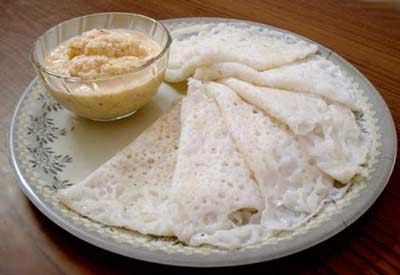
So, I woke up to my favourite Indian breakfast - a veritable mountain of "panpalehs" (see left - a.k.a. "neer dosa") - sort of like pancakes but with a rice-batter, and with a texture of lace. After that came a round of fruit (sweet limes, plantains), soon followed by a round of sweets - jalebis, mithai ladoos, chocolates and more (click for images).

Then, one by one various relatives/friends invariably drop by the house to wish you for your birthday. As is customary, they are offered a tray full of the above sweets, and of course the birthday boy is obliged to match whatever anyone else is eating pound-for-pound. At some stage the eating blends into lunch - the usual table full, this time with two meat curries, one vegetable curry, some fried chicken, two types of rice, appams (something like giant rice chappattis), and probably more. Lunch is followed by more fruit and more sweets, and the latter then runs through to evening, when the real feast happens (as all the family comes together in celebration). So add to the mix chinese fried rice, manchurian-style chicken drumsticks, another chicken curry... and then of course birthday cake afterward.

It goes without saying that, although still a highly trained athlete, I am no longer quite in the shape I was after 4 weeks of daily runs (nothing like the boredom of revision to spur on exercise!). But don't fret - my grandma assures me that "it doesn't matter - you're on holiday!"