Showing posts with label India. Show all posts

Wednesday, 17 February 2010

The Rio juggernaut goes on...

RIO DE JANEIRO, BRAZIL - 17th February 2010

After the epic scenes of Monday (both day and night), it will be scant surprise to hear we were absolutely shattered come Tuesday... after finally rising some time in the afternoon (going to bed at 7.30am isn't ideal for an early start). Feeling somewhat obliged to do something, however, Anna and I hopped into a bus and headed down to Ipanema where, after topping up the energy levels with the delicious açai berry-fruit-shake-juice stuff that is found in the fruit juice stalls that come ten-to-the-dozen all over Brazil, we walked over to Lagoa Rodrigo de Frietas and rented ourselves a couple of bikes to rekindle memories of Oxford as we cycled around the 7.5km path. I'd wanted Anna to see the amazing Ipanema sunset that we'd enjoyed before she arrived, but unfortunately we ended up getting to Ipanema beach about 20 minutes too late... although we still had time to see Anna's compact digital camera (as opposed to her all new fancy SLR one which we left back at Rita's for its own safety) come to a sticky end thanks to an over-zealous wave and the splash of few drops of salty sea water. To say she was unimpressed would be a rather large understatement.
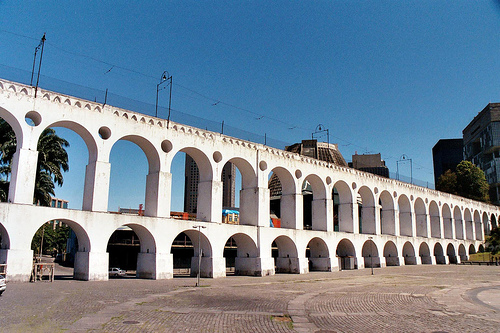
We managed to pass several hours sitting on the beach, walking up the beach, sitting on the wall while drinking some beers... generally mitzing around the area, before we decided to look into hopping on a metro train home. The metro runs 24 hours a day during carnaval... but unfortunately the powers that be had decided that carnaval refered to the sambódromo (which finished on Monday night), rather than the carnaval de rua on the streets that continues till Tuesday. Bad news for us, and adding to our woes was a complete lack of cash for either of us, and apparently no working ATMs in Ipanema. Eventually we bought a couple of drinks by debit card at an Irish pub and got 100 reals cashback to sort ourselves out... and as tends to happen when you're just seeing where the night takes you, we ended up with an English lad, a Colombian, and some guy who was presumably American, overfilling a taxi to Lapa (the centre of Rio nightlife). Ostensibly we were only heading there to try and get on the metro (as apparently it would still be running further up the line), but once we were out on the crowd-filled streets with the full noise and energy of the last night of carnaval, we were always gonna stay and soak up the atmosphere. Wandering over to Arcos de Lapa - a big viaduct of arches across a public square that, by day, looks like the photo on the right - turned out to be a great move as we found ourselves in the midst of a live performance by some sort of band - a good 10 thousand people dancing away in front of the constructed stage. It was probably about 2am when we decided to call it a night... cue walking around to find a metro station, only to discover that it too was closed! Cutting our losses, we just got a cab.

Today was to be different, however, with Rita driving the two of us down to Prainha beach - a recommended spot due south of Rio; bright sands enclosed by green hills (see right) and with the big surf that seems standard along the southern Brazilian coast. Several hours were spent relaxing; Anna wistfully watching the surfers enjoy what are supposed to be the best waves in Brazil, while dismayed by the total lack of surfboard-rental establishments anywhere in Prainha (or indeed anywhere around Rio); I taking some crappy photos. At some stage, however, I had the fairly unusual experience of being stunned to silence after she recounted her torrid time in India and, point-by-point, presented her case for how - in seemingly every conceivable way - India was a disaster of a country. Normally, it takes barely a flicker of criticism of India for me to launch into a strong-worded and generally over-excited defence of the motherland - a personality trait that has provided much easy entertainment over the years for serial windup merchants like Paul "P Sizzle" Smith. On this occasion though, what hit me wasn't so much a flicker of criticism as a raging inferno of lambastations, denunciations and disparagement whose content might been vitriolic if it hadn't all been built upon experiences that were undeniably Indian, and presented in a manner that was perfectly fair. It was an impressive argument on her part, and it was its volume as much as its content that left my quietly collecting my thoughts for some time - wondering why I wasn't at all offended or surprised, but merely disappointed. The overarching conclusion for me eventually seeped through though - travelling can be wildly influenced by preconceptions and expectations, and if they don't include an expectation for anything and everything to come your way - as much in terms of trival customer service standards as the more serious dangers of theft and illness - then 4 months in India are gonna be tough.

The irony for me is that the vehemence of her criticisms simply highlighted the chasm in my mind between what I consider normal anywhere in the world, and what I consider normal in India, and how at ease I am with this division. Repeatedly saying "it's just how it is" wasn't a particularly strong argument on the face of it, but combined with a sense of expectation and it starts to take a deeper significance. Every time I found myself resorting to the same sentence merely served to confirm the sense of ease I feel in a world that was just so foreign for her.

As we drove home conversation turned to just how fantastic a city Rio is; with everything she would want from a city present in Rio, Anna said she'd certainly be happy to live here. I love the place, but my love of London, Kent and the UK is enough to stop me ever seriously thinking about the merits of settling down anywhere else for longer than a few fleeting moments. What I realised, however, is that if the afternoon's conversations achieved little else, what they did do was increase my desire to one day live and work somewhere in India.

Tuesday, 24 November 2009

Indian Farewell

MUMBAI, MAHARASHTRA - 24th November 2009

It's the end of days for Mumbai - tomorrow I depart on Qantas flight 52 to Singapore as my 7-month journey heads another step eastward. However, departure is not before a couple more action-packed days...

Our journey back from Matheran turned into a minor epic - after climbing up we decided to take the toy train back down, and hop onto the mainline suburban train from the bottom of the hill. The toy train journey was epic - certain stretches provided spectacular panoramic hilltop scenery akin to that of the Bangalore-Mangalore line through the Western Ghats (photos will follow in a few days); the difference being that our toy train ran on a 2ft narrow guage and simply worked its way progressively down an isolated hill, as opposed to carving a route through the middle of a range.  It was 2 hours down to Neral at the bottom, but it was there where the wheels somewhat fell off what would have been a relatively quick journey back to Mahim.  It turned out - much to our chagrin - that the Central Railway line into Victoria Terminus was undergoing Sunday maintenance for a stretch of our journey, so we'd have to switch to bus.  

Simple enough?  No chance.  

Unlike the UK, when weekend maintenance is pre-planned and forewarned with posters for months in advance (leave alone announcements to the same in pretty much every station within 100 miles), this is India.  Maintenance wasn't mentioned when we bought our tickets in Matheran, and it's a fair probability that most of the people at Neral station had no advance notice either.  The consequence, naturally enough, is another aspect of chaos - our train terminated at some station up the line and we exited the station to find a state of total bedlam.  Buses were nowhere to be seen, instead was a wall of traffic punctuated with auto-rickshaws jostling for the custom of the hundreds of displaced rail passengers, themselves pouring out of the station and out into the middle of the vehicles.  And a scene of general bedlam was finished off by the ongoing construction of the new Mumbai Monorail directly above our heads and on top of the middle of the road.  

Auto drivers are a crafty bunch, and they clearly they'd got wise about railway maintenance - rates across the 10-15km distance to the next station were off-meter and suitably hiked up.  However, with little alternative and my 7-year-old cousin generally unimpressed with the state of affairs, we hopped on board one - only for the driver's seat to be flanked by another two lads heading the same way.  One auto-rickshaw, 6 adults and a kid, at the height of the midday sun... combined with a massive increase in traffic due to the rail passengers... and you have yourself an hour and a half journey and a half.  Personally, I loved it - going on the old "When in Rome" dictum, there's little India does better than chaos, so make hay when the sun shines!  

Monday was supposed to herald a trip to the Elephanta Caves - a UNESCO World Heritage Site located on Elephanta Island, an hour's ferry from downtown Mumbai.  Thankfully, however, Anna called us up just in time with insider info that the ferries don't run on Mondays... so the trip got postponed 24 hours.  Instead, my uncle gave me a comprehensive tour of downtown Mumbai on his motorbike - with the 2 wheels of the bike we were able to cover a distance in 2 hours that would have probably taken at least double on 4 wheels.  It's always satisfying when you realise you roughly know your way around a city - particularly one as intricate as Mumbai - so I was pretty pleased with myself whenever I knew where we were and where we were going!

The trip to Elephanta did indeed proceed 24 hours later, and we got on board a launch from behind The Gateway to India - adjacent to the Taj Palace Hotel that was the centrepiece of the terrorist attacks here almost a year ago to the day.  It's about an hour's ride to Elephanta Island, from which you have a 120-step walk up to the Main Cave.  First, however, came entrance fees - and another opportunity for an argument over whether or not I could get away with paying the "Indian" rate of Rs.10, as opposed to the foreigner's rate of Rs.250.  Mssrs. Dowson, Marshall and Nimmo will remember similar situations occuring fairly regularly last year - most notably at the Taj Mahal in Agra, which boasts one of the most crooked pieces of price discrimination I've ever seen.  Indians: Rs.10.  Foreigners: Rs.750.  It's a safe policy - no foreigner is going to mind paying the equivalent of £10 to see one of the most beautiful structures on Earth, and furthermore no one who's come all the way to the dump of city that is Agra is going to leave without seeing it's only jewel.  But the audacity of charging 75 times the rate... unbelievable.  

Anyway, my uncle told the guard that I'm from Mangalore, and I had to answer to a bit of cross-questioning, but after various backhand comments from all sides I got in for the "proper" rate (though there was no chance of this for Anna the Ukrainian!).  The Main Cave is spectacular - the walls are filled with intricate carvings of Hindu deities and scenes from mythology (such as the one of Ardhanari to the right - a half-male, half-female god) - but, much to my disappointment, the supposed army of theiving-monkeys on the island failed to materialise.  And having seen the litter pollution dumped near some of the island's other caves, it's apparent that despite its UNESCO status, Elephanta is typical of many places in India - a cultural monument that needs a great deal more care and attention in future years to ensure its proper preservation for future generations.  

That's pretty much my story from India tied up though... 7 weeks of travel have already flown by, and from here it's Singapore and onward.  I'd like to take this opportunity to say a massive thank you to everyone who has fed, housed, entertained or otherwise helped me over here.  India is home, so needless to say I'll be back.

Sunday, 22 November 2009

Monkeyland

MATHERAN, MAHARASHTRA - 22nd November 2009

As I'm in Mumbai for the best part of a week - far longer than the usual 2 days stints we have en route to/from Mangalore we decided to take the opportunity to make an excursion out of the hustle and bustle of the city and out to the peace and tranquility of the countryside. In particular, we were heading up to Matheran, a hill station a couple of hours drive from Mumbai that, for reasons jovial and practical, has gained the nickname "Monkeyland".


View Larger Map

Matheran's location due east of Mumbai is shown above, but a better appreciation of its geography is possible with the zoomed in image below. Matheran sits alone at an elevation of about 800 metres, with the nearest road ceasing above half way up the hill (visible on the map to the north-east). Thus, access to Matheran is possible only by foot, horseback, or by a "toy train" railway built under the British in 1907.


View Larger Map

Keen for a good stroll, my uncle, aunt, cousin and I all began the 2-3km trek up the hills towards the town centre at the summit, and although the ground was awkward rubble the going was good thanks to the deep shade offered by the sprawling, thick canopy overhead. On occasions when the path up winds towards the edge of the hill, you get to see the spectacular views in all directions that, along with its cool, shaded climate, caused the British to develop Matheran into a summertime resort away from the stifling heat of Bombay. As it transpired, the hill was a bit much for a 6-year-old (my cousin), so half way up we got hold of a couple of horses (named Bunty and Bombay) and the ladies saddled up for the rest of the journey (see right).

Up at the top we checked into a hotel and relaxed till lunch, then commandeered a couple more stallions and went for a tour to a few of the "points" (viewing points) around the edge of the hill. The afternoon's horses - Asterix and Gentleman - were thoroughbreds - Gentleman in particular was a mighty animal. Apparently most of the horses up in Matheran are all retired racehorses, but it is safe to say they are treated very well - it shows in the physical stature of the beasts.

Our tour was a couple of hours and took in some even more spectacular views from Lord Point, Echo Point, and a couple of other points whose names I forget (although they weren't Suicide Point, whose name is certainly one to remember). My uncle and I happily digested our lunch while we walked alongside the horses, while the riders enjoyed the power and agility of their steed over the rough terrain. All in all, an excellent afternoon.

The evening brought with it a multitude of monkeys, all keen on getting a piece of any and all food they could muster. We'd already had a couple of our roti breads stolen right in front of our eyes while we were eating lunch, so were were somewhat more cautious while we had our tea. Others were less so, and we all had a good laugh as various gangs of primates ran riot all over the place. The bins were floored and foraged, leftover tea was downed, sugar pots were spread across the table and unceremoniously licked. The kids gathered around all thought it was hilarious; the hotel management less so.

Before dinner we all got ourselves a massage, though as was the theme of the weekend, monkeys would have to influence things in some way. As it turned out, I was downstairs in the forecourt accepting the challenge of the barman to a best of 7-frame game of pool, when my uncle suddenly shouted "oh shit!" and ran upstairs. A particularly industrious monkey had managed to prize open the balcony door, and was happily scouring our dining room for food while my aunt was obliviously having her massage in the bedroom. Soon enough, however, the masseuse noticed a furry friend, and things got pretty excitable till he was cleared off. He'd be back...

Incidentally, I did my bit for British sporting pride by winning 4-0 in the pool stakes (including a spectacular 8-ball running tight to the cushion at an angle, the length of the table...)

Anyway, the final episode of our time with the monkeys came as we were about to leave in the morning - we awoke to find an army of the creatures on our balcony, feasting on the contents of some poor sod's tupperware container full of various tasty morsels. When I say an army, I mean there were at least 14 of them there - including a few little baby monkeys (see right) who looked pretty much identical to your archetypal alien (also see right). The lot of them sat there watching us through the glass French doors, and naturally enough we sat there watching back (or, as the case was for me, clicking about 200 photos). Finally, we decided we didn't want any more of the sweets (jelabis) we'd been eating, so out onto the balcony they went. Unfortunately, the first mover was one of the big daddy monkeys, so the rest had to sit and watch as he first tried to eat it in one, failed, pulled it out his mouth, cracked it in two, tried to put both pieces in his mouth at once, failed, pulled one out again, ate the first one, broke the other half into two, ate both halves, then proceeded to lick the cardboard box of every last follicle of sugary syrup possibly left. All the while, little baby monkey stood with the pose of circus clown.


I've always said, largely in jest, that I want a pet monkey. Post-Matheran, it is no longer in jest... they are seriously cool creatures.

Friday, 20 November 2009

Departure and Dharavi

MUMBAI, MAHARASHTRA - 20th November 2009

Surprise surprise, leaving Mangalore yesterday wasn't exactly fun. Without wanting to sound like a broken record, leaving "home" is a pretty uniquely emotional experience for me (and, I guess, most of my family), though trying to articulate why is always hard - after all everyone always says and knows holidays have to come to an end - and 6 weeks is certainly enough. The only way I can think to describe it is like this: coming to Mangalore isn't so much a holiday, which is a break from your normal life, as a shift to another, equally integral part of your life. So when you leave, you're also leaving that part of your life too... which is pretty gutting. What made it harder than usual was that, unlike almost every other time I've left before, this time I had no idea when I'd be back again.

However, it's pretty pointless for anyone to sit dwelling on sorrows, especially when time in India is limited - and coming to Mumbai presented 6 days to achieve a whole swathe of new experiences, beginning immediately after i landed yesterday with a trip to a Hindu wedding. As is standard here, there were something in the region of 1000 attendees - all dressed in the most vibrant colours imaginable, and none moreso than the bride's family. The level of gold and general jewelry on display would have had a souk owner licking his lips - there were things glistening on pretty much every part of every girl/woman's body. It would have made an excellent fashion parade.

The bridal couple had, funnily enough, been inadvertantly set up by my aunt. As kids they'd played together in the same block of flats, but years later, when they were teenagers, my aunt gave them and a load of friends a bunch of free tickets to the movies. These two sat next to each other, and the rest is history...! (As an aside, kudos to my Dad for jumping at the opportunity to suggest Mamta give me some free movie tickets... )

I jumped from one end of the opulent spectrum to the other today though, when fellow Pembrokian Anna (lately of "Young Pavlova" fame) invited me to join her and her friend on a tour of Dharavi - Asia's biggest slum. The tour was pretty impressive - people see Dharavi stretching for miles in every direction when they come in to land in Mumbai, but only by being on the ground can you appreciate the sheer level and scale of industry happening under the corregated iron rooftops. Our tour took us inside plastic recycling houses (guess where you're white recycling bags in Sevenoaks ultimately end up...), leather manufacturing shops, pottery barns and bakeries. For sure, every one of your senses takes a battering - the sight of rotting garbage, the stench of sewage, noise of machinery and motors in every direction, and of course kids jumping to shake hands with you every step of the way - but it's great to see how people don't stife in adversity, but work as hard as the next man. The place may be a slum, but it's got the productivity of Canary Wharf - perhaps not in value, but certainly in effort.

En route, I jumped at the opportunity to bowl a few balls at the local slum kids playing make-shift versions of cricket. It really is true that whatever language you speak, or wherever you're from - sport unites everyone.

Wednesday, 18 November 2009

The All-Day Eatathon

MANGALORE, KARNATAKA - 18th November 2009

First things first - thank you for all the texts, phone calls and facebook messages for my birthday yesterday; a special mention must go to "Young Pavlova", who managed to achieve all of the above inside the space of 4 and a half minutes.

Those of you lucky enough to catch my facebook status yesterday would have seen something along the lines of "Dean is in the middle of an involuntary all-day eatathon". I feel it is something worth expanding upon, as the involuntary nature of it is fairly integral to any proper description of life in Mangalore.

As a general rule, life in Mangalore revolves around 3 things - breakfast, lunch, and dinner. If you're a local, various other things probably also feature, but the above are the Trinity of the God that is food. And, funnily enough, it is never more apparent than when a visitor arrives in town.

A visitor in the house means even more food than usual. If 4 people are eating, the food on the table should - as a conservative estimate - be enough to feed about 15, or else there's not enough prepared. And, in order to make the maths work, each of the 4 will be expected to eat the quantity of 4 normal people. I've already mentioned that the concept of a "light lunch" has yet to come arrive in Mangalore - if you're a guest in a house a third helping is nothing short of compulsory. You'd sooner be castrated than be allowed to finish without taking a second.

Over the years, I've been known to somewhat exaggerate in order to make a point; indeed the term "a Deanism" (defined roughly as "a statement that is so confidently uttered that it is assumed true, but is in fact either partially or wholly made up") had a brief foray into popular usage during my second year of university. However, it is safe to say that on this occasion the level of exaggeration is low-to-medium - as any "Mangy" will testify.

Occasionally though, a perfect storm of factors come together to create a near-apocalyptic level of compulsory food intake. Such an occasion took place on the 17th November 2009, as my birthday combined with a "Last Supper" in light of my impending departure from Mangalore. To put this in brutal terms, the usual "you've-got-to-eat-more-because-you're-on-holiday" orders were combined with a celebratory "it's-your-birthday-therefore-you-have-to-eat-more" special, itself conversely punctuated by the more sombre "you're-leaving-in-two-days-so-you're-got-to-savour-the-food" line of argument. Thus, the usual 3-Feasts-in-a-Day consumption model was thrown out the window, instead replaced with a Perpetual-Eating model that follows the rule "any second you're not eating is a second wasted".

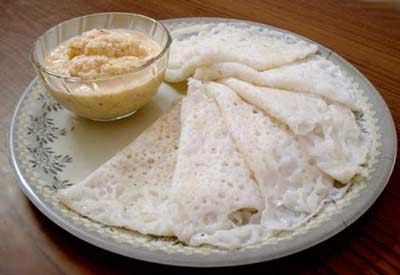
So, I woke up to my favourite Indian breakfast - a veritable mountain of "panpalehs" (see left - a.k.a. "neer dosa") - sort of like pancakes but with a rice-batter, and with a texture of lace. After that came a round of fruit (sweet limes, plantains), soon followed by a round of sweets - jalebis, mithai ladoos, chocolates and more (click for images).

Then, one by one various relatives/friends invariably drop by the house to wish you for your birthday. As is customary, they are offered a tray full of the above sweets, and of course the birthday boy is obliged to match whatever anyone else is eating pound-for-pound. At some stage the eating blends into lunch - the usual table full, this time with two meat curries, one vegetable curry, some fried chicken, two types of rice, appams (something like giant rice chappattis), and probably more. Lunch is followed by more fruit and more sweets, and the latter then runs through to evening, when the real feast happens (as all the family comes together in celebration). So add to the mix chinese fried rice, manchurian-style chicken drumsticks, another chicken curry... and then of course birthday cake afterward.

It goes without saying that, although still a highly trained athlete, I am no longer quite in the shape I was after 4 weeks of daily runs (nothing like the boredom of revision to spur on exercise!). But don't fret - my grandma assures me that "it doesn't matter - you're on holiday!"

Friday, 13 November 2009

Beyond Belief

MANGALORE, KARNATAKA - 13th November 2009

Every so often something comes along that unites almost all people in communal disbelief. September 2008 saw one of those occasions, when a bunch of Hindu fundamentalists turned up at at a small chapel here in Mangalore armed with swords, iron bars and wooden clubs, and proceeded to smash the place - and anything and everything inside - to pieces. Those unfamiliar with the events should read the Enquiry Report, which gives a full account that I won't repeat here (and also explains the significance of certain things if you're a non-Catholic), but a brief summary is found on Wikipedia -
A group of youth from Hindu nationalist organization went inside the chapel of Adoration Monastery of the Sisters of St-Clare in Milagres and, in a quick succession, desecrated a crucifix, the tabernacle and the Eucharist, the monstrance, the oil lamps, the vases on the altar and a few statues of saints.
Up to 10 churches or prayer halls were attacked the same day across Mangalore, and the following days saw mass protests from Catholics in the area. At the Monastery, the battered and beaten crucifix, itself a heritage work of rare art, was left as it was for all to see - and subsequently has been placed in its own glass case outside the Chapel.

Yesterday we visited the monastery - a small, modest place hidden away from the busy Falnir Road; accessed from a tiny lane too small for vehicles to pass, noticeable only from a small sign off the main road. The monastery itself is private for cloistered nuns, but as a "Perpetual Adoration Monastery", the linked public chapel is always open, with the Blessed Sacrament always on display (see Enquiry Report for explanation of the significance of the Blessed Sacrament).

As you enter your eyes are drawn to a corner of the small lobby area, outside the entrance to the Chapel. Whether though instinct or conscious thought, you cannot help but shake your head as you approach; the shock of seeing the battered, broken pieces of the Crucifix slowly sinking in as you move closer. The Crucifix, alongside is smashed Monstrance, is encased in a glass display; the glass marked simply with "14/09/2008, 10.20am", and the words "Thus, I Loved You".

As I'm still unable to get my photos from the computer to the net, but this photo of the Crucifix is found on Manglorean.com.

I'd seen the photos like these over the internet from England last year when it all kicked off but, like so many things you experience through life, the chilling, spine-tingling effect of seeing it first hand invokes feelings that can never be felt through a photograph on a screen. Leaving religion, creed, and anything else aside, you are forced to sit back and wonder what sort of mindset could possibly possess someone (or several people) to do something so shocking.

But, at the same time, seeing it out on display as it is - a constant reminder for all to see - has the same symbolic resonance as seeing the US flag fluttering above the rubble at Ground Zero, or the bullet holes left littered on the glass of the still-bustling Leopold Cafe in Mumbai. You can safely say that some things will never die.

Monday, 9 November 2009

Sunday Drive XL

MANGALORE, KARNATAKA - 9th November 2009

Sunday afternoons represent another long-standing family tradition in Mangalore - the family drive. The number of family taking part fluctuate (other than my grandma, whose presence is a given), depending on who's actually in Mangalore, but with both my uncle down from Mumbai and myself present, at 4.20pm yesterday we were all systems go.

In my newfound capacity as family driver, I took the wheel as we embarked on a leisurely cruise up to Bajpe Airport - the colloquial name for Mangalore Airport (taken from the name of the area adjacent to the old terminal building). Much like all of Mangalore, the airport is currently in the midst of a massive redevelopment - the first stage of which involved the construction of a brand new runway.

In days gone by (specifically, up to 2006 or so), landing at Mangalore would have been one of those outside-the-box challenges that broke pilots' collective boredom from daily metronomic routine. The old runway was short - very short - with a 500ft sheer drop into valleys at either end. To put it in perspective just how short is short, a standard airport runway (e.g. Heathrow) is 12,000ft long (a bit over 3500 metres); the old Mangalore runway was 1615 metres. So with a less-than-half-length runway to deal with, pilots landing at Bajpe had to decide by half-way down the runway whether they had enough time to come to a halt, or else re-accelerate and try again second time. Not for the faint of heart at any time, but come between June and August and you're combining an already dubious landing with an ever-changing wind direction (the airport's on top of a hill), the liquefied battering of monsoon rain, and visibility on a par with the Sahara desert at midnight. Pretty grim.

But what with India's explosive growth and Mangalore's increasing importance in Karnataka and in general in southern India, a half-baked airport was never going to last long (however entertaining it was for kids travelling with mothers who already hate flying). A brand spanking new runway was built, alongside 24 hour approach lighting (allowing for night flights), and all of a sudden Mangalore was an international airport - flights from all sorts of Middle East destinations turn up every day. But the second part was the building of a new international calibre terminal, which is now almost complete.

This blog may seem to have swung wildly off topic, but the crux of the story is that while we were driving up en route to the old airport - a 30km ride all the way around the hill that Bajpe sits on top, we chanced our luck on the new concrete slip road towards the new terminal (built on the "front" on the hill, thus knocking half the distance off the journey). The road has literally been constructed straight up what was a sheer cliff - imagine a concrete dual carriageway, breaking every 25 metres into a huge hairpin bends). The engineering to get the road built is spectacular, but not half as spectacular as the view from the top. To the south west lies the city centre of Mangalore, its urban sprawl contained by the rivers that surround it, and out beyond the Arabian Sea spreads out into infinity. To the north-west lies MRPL - Mangalore Refinery and Petrochemical Ltd. - a massive refinery complex (surprise surprise) that is one of the major heavy industries located around the outskirts of the city... but it turned out we'd be seeing a lot more of it that I thought at the time.

Thoroughly pleased with ourselves for seeing the new terminal building and the view for the first time, we heading back down, but decided to head on up to the old airport anyway. Getting closer there, we decided to wing a left and head towards the Bajpe village... and then one thing led to another and we kept driving down the road. I say "one thing led to another" - one village led to another, and bar a good sense of direction none of us really knew where we were - other than that we were heading north so we should stick a left somewhere.

Eventually we saw a sign that suggested we'd arrived in Kateel... I'd be lying if I said I'd ever heard of the place but it seemed to register with the others, and so onwards we marched (*drove) through some of the best roads I've ever seen in South Canara district. It was just like driving down a typical English countryside road - smooth as silk, greenery sprawling in every direction either side of you, and not a car to be seen for 10, even 15 minutes at a time. At one stage, far over to our south-west, we saw the massive exhaust towers of the MRPL complex... a fair reflection on how far we'd come.

Eventually we ended up in Kinnigoly, and passing the opportunity to pick up some good looking watermelons, we head westward to National Highway 17, and bombed it back down the coast to Mangalore - now passing MRPL from the West. Final journey distance? According to a Google Map I just drew, a cool 65km...

And you can see all the details - including Howzat's location - below! Double-click to zoom in...


View Long drive in a larger map

Tuesday, 3 November 2009

Blessing of Graves

MANGALORE, KARNATAKA - 3rd November 2009

In 21 years, this is the first time I have left England in the months of October or November - months that co-incide with a whole host of festivities/celebrations in India. Things like Diwali and pretty well known, but here in Mangalore with its massive Catholic influence, there are certain Christian traditions that are pretty special over here.

Sunday, the 1st November, is one of them - the annual blessing of graves on All Saints Day - the eve of All Souls Day. You can't really say you "like graveyards", but in what is probably another facet of Mangalore feeling like home, the graveyard behind Milagres Church has always seemed like another sort of home - a place where all my family - both my Mum's and Dad's - are buried going back countless years; a place that, in the words of one of my aunts, "unites everyone". It is something I've rarely seen in the UK - probably because families move far and wide so there's no real concept of "home"... but Mangalore is in many ways a very insular town (/city) - particularly among the Catholic community.

Anyway, just before sunset on the 1st November, all the families of the Departed gather around the graves of their family members - the graves themselves are adorned with flowers, candles, and petals and whole families will gather together around their common stones. For us, we gathered around the grave of my maternal grandfather, although I was also able to be present at my paternal grandparents' grave a little way across the graveyard. The whole place is full of people - the vast majority of graves have at least someone around them - and after some introductory prayers, several priests process between graves, blessing them and scattering holy water.

Every year on the 1st November, my Mum has always told me about the Blessing of Graves back home, and what a beautiful ceremony it is; naturally my imagination formed some sort of vision of what to expect. Nevertheless, being part of it first-hand is something that cannot be described fully with words. The graveyard itself is lit up, shining like a beacon in the surrounding afterglow of sunset, and in among the immaculately maintained footpaths and flowerbeds hundreds of people move among glistening tombs, assembling together around a common family member. After some initial prayers from the Parish Priest, several priests disperse among the graveyard, each sprinkling Holy Water over the graves in their designated area, their movements followed by the background echo of a choir.

It is something that has to be experienced to be appreciated, but there are few things that make a family, regardless of circumstance, feel closer together than when united in love and memory, alongside a whole community of friends doing the same. It is something very special in Mangalore - there aren't many other places that have the same Catholic heritage but equally have families that have remained true to their roots - even those that have spread far and wide invariably return.

Monday, 2 November 2009

An Indian Perspecitive (on F1)...

Closer followers of my journalistic career may be aware that over the last year I've been moonlighting as a guest contributor for The Times'* (award-winning) F1 blog. Having watched the first race I've seen in a month yesterday, and in the spirit of being in India, I've just written something for the first time in a while. Those interested can read the transcript here. As a mouth-watering taster of the fascinating insights that follow, here are the first three paragraphs:

I've been in India for the last month as the first stage of a "gap year" tour around the world (which coincidentally explains my total disappearance from this blog since September), and as this season ends I feel obliged to provide some sort of voice for what could well be F1's largest worldwide following.

Due to various travels, I ended up missing the live telecasts of pretty much the entire climax to the season, with the exception of yesterday's Abu Dhabi bonanza. However, that is in no way reflective of the coverage of F1 over here - whether or not you watch the race, you'll be sure to find out the result whether you want to or not. I think this is the 15th time I've been India (my "other" home), and this has always been the case. Every qualifying and race is broadcast, but more pertinently the practice sessions are covered as well - something we lacked in the UK for years until BBC took over again this season. Coverage in the print media is also excellent, and for good reason too - after cricket (which you are better considering as a religion than a sport here), F1 probably garners the second greatest interest across the board.

As I say, this has been the case for years. My love of F1 almost certainly developed here in India as a 6-year old tyke, when my uncle would sit me down every Sunday to bear witness to the ministry of Michael Schumacher back in his Bennetton days. "Man over machine", as he would describe it - and too right he was. And certainly, I have met no one anywhere else in the world more passionate and knowledgeable about the sport than him. And while he is an individual, he's a representation of F1's following in India - it is everywhere. Drive around the roads here (at your peril), and you'll be passed by many a 2-wheeler, wriggling between cars like a rat on wheels. What you'll quickly spot is the remarkable number of moving adverts for Marlboro cigarettes... and indeed for various other brands that happened to adorn Michael Schumacher's helmet back in the day. Since helmets became compulsory a few years back, replica's of MS's design have sold like hot cakes - though the odd replica Alonso and Hamilton wouldn't be a total surprise on the streets of Mumbai. What strikes home is that the appreciation of the sport in the country - the passionate following of a team or a driver that has been present in India for years on end (certainly throughout my lifetime) - is totally independent of national interest. (continue reading)

For those really interested, some of my previous F1 articles for The Times' blog can be found here, here or here.


* I keep seeing and keep getting annoyed by the same repeated mistake - particularly in the US media. "The Times" is the original Times newspaper, and is called The Times. Not "The London Times" or "The Times of London". And yes, it also invented "Times New Roman".

Sunday, 25 October 2009

Parklife

BENGALURU (BANGALORE), KARNATAKA - 25th October 2009

While achieving minor fame on the side, I was able to check out some of Bangalore's sights with various relations (and get some more "Back the Bid" photos). Meeting up with a cousin, we went for dinner to "UB City" - a mini-Manhattan in the heart of Bangalore built by Vijay Mallya - owner of United Breweries (of "Kingfisher" fame)/tycoon/India's answer to Richard Branson - on the site of an old UB brewery.

It is like stepping into another continent. One minute you're driving down a half-built road inhabited by half-brained drivers driving half-smashed cars in what is best described as "classical" India - the next minute you're in the plushest New York city centre shopping complex with clean crisp multi-story parking, classy restaurants and outdoor piazzas and ultra-modern glass towers surrounding you - the tallest of which is a model of the Empire State Building. You've gotta take your hats of to Mallya - the guy's his own self-proclaimed brand ambassador - he doesn't need celebrities to endorse the Kingfisher brand when he's living the dream himself. For example, a few years back for his 50th birthday, he hosted a mammoth party in his bungalow in Goa. As you do, it was decided that a fly-by of Kingfisher Airlines' latest Airbus fleet should be organised, so a few phone calls were made and Goa airspace was closed for half an hour while 10 jet airliners cruised around Panaji. In India, great wealth always equals great power...

Roaming around with my uncle during the day(s), we also managed to check out some of the city's historical eating establishments, including Koshy's on St. Mark's Road - around since 1940 and caterers to HM Queen Elizabeth and the late Prime Minister Indira Gandhi; and Mavalli Tiffin Rooms - a quality thali joint on Lalbagh Road that represents the home of the MTR brand, now known internationally for various powdered spices, coffee, and various other pre-packaged bits and bobs. A quick Google search suggests they've even done well enough to have their own Wikipedia page!

Just down the road from MTR is one of Bangalore's landmark sights - the Lalbagh Botanical Gardens. The self-styled "Lung of the City" is a huge park right in the middle of town that features - as you would expect from a Botanical Garden - all sorts of plantlife from pretty much every climate across the world. It is always nice to be able to wander around an area that, despite being slap bang in the middle of one of Asia's busiest cities, has the peace and tranquility of the middle of the ocean - the cooling breeze lifting off the park's lake combined with the swathes of shade provided by towering canopies of tropical trees transport you to a whole new place - open space, clean air, quiet... it's all so anti-Bangalore!

While Lalbagh Gardens was a spectacular showcase for the flora of the region, a Sunday afternoon safari trip to Bannerghatta National Park very much ticked to fauna box. After shifting residence from one cousin's place to another on Friday night, we went on a big family trip - about an hour and a half's drive to the south of the city. The place must be about 1000+ acres, and is divided into various reserve enclosures for different animals. In a manner somewhat similar to Jurassic Park, you hop on board a safari bus and head off into the wilderness. Every so often you reach a gateway that opens up into another gate - a sort of double door mechanism to stop any of the big cats/bears escaping and going on a rampage - but within the gates you are treated to groundhogs and bison; bears; lions; tigers; and white tigers, in enclosures 1, 2, 3, 4 and 5 respectively.

As I say, the enclosures are huge - once you're inside it is very much like you're out in the open savanna, and the bus driver uses his experience to spot various animals at a distance where possible. But occasionally, as anyone who's been on a safari will know, you're lucky enough to catch one up close an personal... and the thrill of my life came as we were approaching the exit gate of the final enclosure.

Kotching on the floor by the gate sat not one, not two, but three tigers. Two white, one red; both looking straight at our bus as it approached. It's worth pointing out that these vehicles are massively re-enforced around the window and engine regions, but you can't help feeling the adrenaline flow as you pull up literally 2 metres away from these three bad boys - sitting, flexing their colossal thigh muscles and generally looking like they owned the joint. The red one in particular had the sort of "I'm the Boss" look of unadulterated power that is blatantly thinking, "I could absolutely munch these guys". There are some killer photos, and they will appear very soon (they're uploaded on the computer, so they actually will be there soon!).


The final chapter of Bangalore before the morning's train journey to Mangalore was a stop at Fanoo's, another famous haunt at Johnson Market. It is no exaggeration to say I've eaten my fair share of kebabs of all varieties in my time, and I was fast arriving at the conclusion that kebabs of the seekh variety obtained perfection at a nondescript restaurant on Drummond Street (near Euston Station in London). However, sitting in the back seat of my cousin's car with his younger son* on my lap, I had a gastronomic revelation on a par with sliced bread. This seekh kebab was perfection wrapped in paper. Apparently the one I had was a "jumbo" size - I could have devoured about 5 on the spot. If rumours of a larger, "mumbo-jumbo" variety are true, my next trip to Bangalore could well be fast-tracked...


* My cousin's younger son - Kevin, 9 - provided an interesting repost to my views on Wayne Rooney. While his elder brother Brian has made use of the wisdom provided by his extra years and supports Manchester United, Kevin has - for some unfathomable reason - decided to support Chelski...

DR: "Wayne Rooney is the best footballer in the Premiership... he's pretty much God's Gift to football"
KF: "Wayne Rooney is a multi-coloured gorilla. And you're also a multi-coloured gorilla.".

The Oxford Union awaits...

Thursday, 22 October 2009

Fame in the Garden City

BENGALURU (BANGALORE), KARNATAKA - 22nd October 2009

5 hours east from Chikmagalur, we cruised up to a wall of traffic marking our entrance into India's "Garden City". The nickname probably came from British - situated on a plateau with one if India's most temperate climates, the Raj's top brass would have felt right at home. Three quarters of a century later, however, and Bangalore is now India's fastest growing city, and recently overtook Chennai (Madras) to become the fourth most populous. As such, the "Garden City" is getting gradually choked - traffic volume matches Mumbai but without any sort of system, and Bangalore presently lacks any sort of effect mass transportation. All in all, driving around is pretty grim.

Our route into the city took as past Chinnaswamy Stadium - home of IPL's Royal Challengers who, as it turned out, were playing their final match of the Champions' League T20 that evening. Personally I've quite enjoyed the whole Champions League bonanza - there's something refreshing about international players playing against one another in mixed up teams, and the tournament has seen some pretty spectacular hitting. The highlight has definitely been the success of Trinidad & Tobago, who were massive underdogs to start with (having no realplayers of international repute) but have proceeded to thump everyone and anyone straight back to last Christmas. I'm sure I'm not alone in thinking that there's a real argument for West Indies cricket to be sacked off and just allow T&T, or any other Caribbean island, to play independently - at least for T20. The way these guys play, they'd beat anyone in the world.

Enough about cricket though. We arrived at Mervyn's place on Saturday night and went over to a neighbour's place for a Diwali dinner. Diwali is, obviously, a massive deal over here, and the three days of celebration (Saturday, Sunday and Monday) are marked with a veritable war of firecrackers. Despite being the "Festival of Light", light-based explosions are fairly rare... "Festival of Noise" is more the theme for the majority of kids running around the streets blowing up God-knows-how-many-thousands-rupees-worth of gunpowder.

The neighbour is an old man called Subhu (spelling could be wrong) who, as it turned out, was a massive fan of Britain and British culture, and a massive fan of cricket. Naturally, I was introduced to him as Dean - comes from London, is a member at Lord's, etc.etc., and within about 5 minutes he was talking to me as though we'd been best friends for years. He'd has quite a few by the time we left, but come 1pm the next day my uncle gets a call asking what I was doing, and whether I'd like to play golf with him! Great character all round.

Golf didn't happen, but instead I was able to catch up with a whole swathe of cousins from my Dad's side of the family - he's one of 6 children, and one of only two not to have a child in Bangalore. We also checked out the famous Bangalore Club, but I'll write more about that at a later stage.

Jumping to Tuesday night though, and my cousin took me to a bar called The Beach (sure enough the floor is sand), where him and his friends meet every week for a quiz-come-music night called "Question Mark". Quality night - despite the fact that I did rubbish (not surprising considering how high expectations of me had been raised) - good music and great entertainment from the Quizmaster/comedian Mark. The night will be remembered for a hell of a long time more, however, thanks to this morning's Bangalore Times - a page 3 feature about the "Question Mark" night included yours truly grinning back at you along with Carry (short of Carissa?) - one of my cousin's friends. International celebrity stardom, here we go...

Unfortunately, they clearly misheard me saying/spelling my name. The caption of the two of us reads "Carry and Team"...

Saturday, 17 October 2009

Arabica, Robusta, and Grandfathers' Godsons

KUVEE (ish), CHIKMAGALUR DISTRICT, KARNATAKA - 17th October 2009

Following in the footsteps of my parents from their last trip to India in January, we decided to head up to a family friend's coffee estate in the Chikmagalur Hills, about 120km north-east of Mangalore. 120km isn't really that far, but through an all too Indian combination of poor planning, poor construction, and gross incompetence in redevelopment of National Highways, the journey takes about 5 hours. Ironically, the road quality improves dramatically once you leave the "Highway".

Once you're off the highway, the drive to the estate is pretty special - in particular the stretch of road the winds its way up and over the Western Ghats. We hit this section just before sunset, and the views looking down were pretty impressive. Think Alpine ridges covered with Amazon jungle plantlife. Again, photos will appear at some stage...

Anigundi Estate is over 100 years old, and has been in the Saldanha house right back to 1899. Mervyn, who is running it now, took over from his brother, who took over from his father, who had taken over from his father... (and possibly another generation in there - I forget). Modernisation has, obviously, gone hand in hand with development as the years have passed, but it's pretty awe-inspiring to think that a sizable proportion of the coffee plants on the estate today are those same plants planted decades ago - Robusta plants, in particular, just keep churning out the produce, year after year.

I don't want to turn this blog into a written lecture, so will brush over the details of the science of coffee-growing - suffice to say that it is very much a science (vastly more so than tea, as I saw first hand). It's seriously interesting stuff though, so consider yourself lucky if, come May, you're on the receiving end of an early version of the soon-to-follow Rodrigues Lecture Series on Coffee Plantation Methods in South-Western India.

Mervyn gave me a thorough tour of the estate, explaining the way everything worked, and pointing out the coffee estate next door (next door being about 3km away) where, about half a century ago, my grandfather (Dad's Dad) used to be Manager, and where my Dad and family used to come and spend their holidays. Pretty surreal experience, especially getting my photo taken with a plant that was almost certainly planted by my late Granddad. Things got more surreal, however, when we stopped to pick up the paper at the local store. I should emphasise that coffee estates are basically in the middle of nowhere, so this one store was pretty much the only place you could get a newspaper within an hour's drive or so. Thomas "Hound Dog" Hughes would appreciate what I'm saying...

Anyway, buying the paper, Mervyn explained to the old lady at the store that I was visiting from England, and my Grandfather used to manage the estate over the road. "What was his name?", he asked me - I reply, "John Rodrigues". The old lady's face nods - "Ah, ya - John Rodrigues!" Her son, Vivian, pipes up - "Ya - he's my brother's Godfather!". Sure enough, they call Chandran (the brother) from inside, and completely out the blue I get to get my photo taken with the Godson of my Grandfather (see right)... a Godson no one in my Dad's family seems to have any idea about! Good times.

Saturday means departure for Bangalore, but early morning we enlisted the help of Kyemala, one of the farm's labourers, to guide us up to the top of the estate's mountain peak - about 4000ft up. Thinking back over my long 21 years of life, I've met some pretty memorable people on my travels - last summer alone brought characters such as "Jonny Depp" (over-sized British backpacker with ideas above his station - think Runciman with a beard), "Mr. Sam" (dodgy tailor in Bangkok who claimed to have ties to the Bombay Mafia) and that crafty devil Akhmed (or something like that) in Jaisalmir - but Kyelama is without doubt my new favourite. First up, he's no ordinary labourer - he's about 75 years old but still fit as a fiddle, and has worked at Anigundi for several decades, before which he worked at the estate my Grandfather used to manage, as well as some stints at other places. All that while, he's never been further than about 10km from that place - but his wife and he are happy as Larry. Every Saturday afternoon is pay day, and by 10pm on Saturday night they've both spent their allowance on liquor and are both high as kites. The wife moreso, as she commands 60% of any alcohol purchased! Below is Kyemala "Backing the Bid":


Anyway, Kyemala secured his reputation in my eyes when we asked how old he was (translated from Kannada/Konkani/Tulu).

K: "What can I say - very old!"
Us: "A hundred?"
K: "Oh yeah, at least a hundred..."
Us: "Reallly?!"
K: "Yeah - lets see, the first place was 50 years, then 50 years here, then
30, then another 50... lets see... it's at least 175..."
...
K: "... and then there's this, and that... I think finally about
275?"
Us: "Ok - excellent!"
K: "Wait! There's another 10 years at the beginning - you've got to
add them too!"

Brilliant.

Sunday, 11 October 2009

Back Home!

MANGALORE, KARNATAKA - 11th October 2009

Something I've always struggled to explain in England is my attachment to Mangalore. A relaxing afternoon drink on Bangkok's Khaosan Road last summer descended, as many of our conversations tend to, into enigmatic debate when I - born in Westminster, raised in Kent - said that I considered Mangalore my home. Simon, supported by Dows, was having none of it, taking the view that your home is unambiguously the place where you grow up - it's a statement of fact that isn't open to interpretation (or something along those lines). My argument, supported by Jamie, is that you can't understand what it's like to have a home away from home unless your family circumstances are such; that the feeling of attachment you have to what you call "home" is something that has to be felt to be appreciated. E&M/Operations management students reading this might want to consider this in terms of Garvin (1984)'s "transcendent quality" - something has a quality that "can be understood only once you have been exposed to [it]"...

Long story short, despite the fact that I've never lived here and was born in the UK, the moment I've landed/arrived in Mangalore I've always felt naturally at home in a way that is unlike anywhere else in the world. It's beyond simply being surrounded by family, or being on holiday - it's something that I really cannot explain, but is pretty much set in stone. One of my uncle's friends asked why we were in such a rush to leave Mumbai - to quote my uncle, "his heart and sole is in Mangalore".

So, as always, I was brimming with excitement when our 16 hour bus from Mumbai rocked up in Balmatta (centre-ish part of Mangalore) on Thursday morning. Arriving at "Howzat" - my grandmother's house - is as wonderful a feeling now as it has been any of the previous 13 times I've been here (albeit I don't really remember the 1988 or 1990 editions). And, as is the way, I've been fed like a pig being fattened for the slaughter since the moment I arrived. The information age has well and truly come to India, but the concept of a "light lunch" or "light dinner" has made little or no headway in Mangalore - breakfasts are huge, lunch is huge, dinner is huger still. God knows where it all goes.

Mangalore for me usually means chilling out, which is pretty much all I intend to do, but I have lots of family from both my Mum and Dad's sides here who I always catch up with. One such visit on Friday resulted caused a chain of events that resulted in a pretty novel experience. One minute I was visiting an aunt (my Dad's sister) - naturally in shorts and t-shirt like a standout foreigner - the next minute I was getting a lift with an uncle (Dad's brother) and his wife to their younger daughter (my cousin)'s school to give an impromptu talk about English life to about 150 schoolkids. The whole thing happened in about 20 minutes, so my "talk" was pretty much as ad-libbed as it comes... but seemed to go down pretty well. The headmistress asked for a show of hands at the end about who'd like to visit England, and everyone was up in the air... good to see!

My cousin's put some photos on facebook which you might be able to see (such as here)... if not my ones will turn up at some stage in the future (UPDATE - they've turned up!).

Till then, I'll probably still be kotching here, working my way through yet another Flashman.

Thursday, 8 October 2009

Rain, rain, go away...?

As has been previously mentioned, after a dry, humid and all-round stuffy first 24 hours, my arrival in India saw greeted with some seriously mega rainfall, with dire consequences for all forms of transport.

Northern Karnataka - immediately south of Mumbai - does not usually experience heavy monsoon rainfall as it is largely on top of a plateau by the Western Ghats. On this occasion, however, it bore the brunt of a massive late summer monsoon, wreaking havoc in the region and resulting the closure of Goa's international airport, the suspension of long-distance rail services down the west coast, and the closure of the main highway linking the southern states with Mumbai.

My uncle, taking an overnight coach from Mangalore (in southern Karnataka) to Mumbai to meet me, basically raced the storms - his coach was unable to return to Mangalore as 4 landslides closed the highway just minutes after they had passed them.

The floods from the rains have caused untold damage and several deaths... but represent one of India's annual ironies - without such heavy rain, the suffering in a few months would probably have been a lot worse.

The day I arrived in India, the headlines in the media concerned the "worst drought in Mumbai since 1972" - a summer of failing monsoons had left the lakes that provide the city with water more than 30% below on required water levels as the monsoon season drew to a close. With next-to-no rain falling between November and May, an urban area the magnitude of Greater Mumbai requires all four of its feeder lakes to be overflowing come the close of the monsoons; the massive failure to do so brought fears of a shocking lack of water next summer.

So while the downpours brought suffering to Karnataka, as those same rains headed further north they brought untold relief to Mumbai's 15+ million inhabitants. Some sort of pun involving clouds, silver-lining, etc., can probably be inserted here.

Tuesday, 6 October 2009

Training

MUMBAI, MAHARASHTRA - 6th October 2009

With our bus tickets to Mangalore booked for Wednesday afternoon, the latest episode of "D-Rod" on tour saw us take the opportunity to go gallivanting around Mumbai's city centre. Stage 1 of the plan, however, involved the not-so-simple task of hopping onto one of Mumbai's infamous suburban commuter trains.

I've been in some pretty damn crowded places in my time - being rammed against the metal barrier in front of 40,000 people at T in the Park to the beats of Kasabian was pretty mental, though in transport terms I always thought the Jubilee Line towards Canary Wharf at 8.45am would take some beating. That was before I saw this video of Japanese "train pushers" ramming a few extra passengers onto the Tokyo Metro:


But - and I'm sure everyone can guess what's coming - Mumbai trains take the metaphorical biscuit. The train pulls up into Borivli station, already with people hanging out the doors. Before the train stops, the wall of waiting passengers engulfs each and every doorway and ram-roads their way into the carriage - it's dog eat dog and anyone left by the wayside gets no sympathy. Tokyo-style train pushers are not necessary not because there are fewer people - there are probably more - but because nobody has any qualms about quite literally rucking their way into the carriage. "Into" is probably an exaggeration - as long as they are close enough to put one foot inside the carriage and have one arm around a handlebar, they'll be happy as larry just dangling outside the door frame. Contrary to popular beliefs, closer examination at a later stage revealed that the trains do, in fact, have doors... but are left perpetually slid open.

Credit where credit's due though - the trains run like clockwork, and the train leaves the station no more than 30 seconds after it arrives - regardless of what anyone is doing or attempting to do along its 16 carriage length. The economist in me appreciated the true efficiency of it all.

Anyway, about 30 minutes later we'd pulled up to Churchgate Terminus in the heart of Mumbai's old city centre - the moment you step outside you see the British influence on all the architecture. Most spectacular is Victoria Terminus - still called VT by everyone despite being renamed Chhattarapati Shivaji Terminus a few years back. VT is up there with St Pancras for grandeur - its outer facade mimics the London termini on which it is based, but towers above its surrounding in a way far more impressive than its British cousins.

Some of you may have heard of/noticed the England 2018 "Back the Bid" campaign on Facebook, where 40 *lucky* supporters got a free scarf in return for sending in photos of them "Backing the Bid" around the world. I managed to snag a couple of photos into the album from my pre-travelling sojourn to Switzerland (here and here), but the real snappy snaps have been here in India. Some classics in Mumbai town included one with one of the world-famous dubba-wallahs (see right). To quote Wikipedia (the source of all knowledge),

More than 175,000 or 200,000 lunch boxes get moved every day by an estimated 4,500 to 5,000 dabbawalas, all with an extremely small nominal fee and with utmost punctuality. According to a recent survey, there is only one mistake in every 6,000,000 deliveries, statistically equivalent to a Six Sigma (99.9999% accuracy) rating.

Photos of this, and several other Backing the Bid cheesy grins, will probably appear on Facebook in due course.

Anyway, we had a fairly comprehensive wander around downtown Mumbai, swinging by the historic Crawford Market (whose structure was designed by Lockwood Kipling - father of Rudyard) for a falooda. Somewhat an acquired taste, faloodas are made by soaking tapioca seeds in water, then mixing them into rose syrup with vermicelli and adding milk, basil seeds, sugar and ice cream. Bloody terrific for digestion.

Moving slight away from the touristy region, we wandered through "Chor Bazaar" - literally "Robbers' Market" (I'm fairly sure it's an unofficial name), where you can pick up pretty much anything under the sun for a bargain price that is solely attributable to the good old five finger discount. I'm reliably informed that if you go there wanting something that they don't have, they'll get it for you within half an hour. I'm fairly sure that whatever economy Liverpool has is built on this principle, but they clearly haven't perfected it quite to the same extent as these guys.

We made time to stop for a pint at Leopold's in Colaba - a tourist hotspot that was one of the places gunned down during the 26/11 terrorist attacks on Mumbai. They've left the glass with bullet holes ridden in as a reminder to all its vistors (see right) - it's always chilling to think that a couple of months before then Simon, Jamie and I were in there being the very English tourists that those nutters were looking to murder. From there we had lunch at a brilliant Goan place called Martin's - off the tourist trail but damn good food. The afternoon passed with various journeys around Mumbai's districts - Worli (to add Mumbai to my collection of Hard Rock Cafe t-shirts), Sion and Bandra were all visited before the forced our way onto a train back up to Borivli. End of days for Mumbai - next stop, home - Mangalore.

Monday, 5 October 2009

96 not out

NASHIK, MAHARASHTRA - 5th October 2009

A day that began with a 4.30am alarm to catch a 5.30am, five-and-a-half hour bus, and finishes with a seven hour return journey back to Mumbai, really doesn't sound like one to write home about. The latter part in particular included one of those painful experiences that is made infinitely more infuriating by the fact that there's absolutely jog all you can do about it (an experience it seems I have the pleasure of revisiting on a remarkably regular basis).

Much akin to getting smacked in the groin and recovering, only to get repeatedly smacked again, we were making great progress on the road until we hit Mumbai. From 6pm to 8.30pm, however, we proceeded to move in the sort of stop-start manner that is arguably more annoying than idiot drivers hogging the fast lane on the M25 (and, as anyone who's been a passenger in my car knows, that is saying something).

Between 12 hours of bus rides, however, we were in Nashik to visit my great-aunt - my oldest living relative and indeed the oldest person in the history of our family. Auntie Martha, going strong at 96, was in great form - albeit form that lacked any memory of who we were or pretty much anything else. I think it's the first time I'd seen Auntie Martha in about 15 years, and I was simply speechless at her physical fitness. Bar memory loss, her body is as fit as a fiddle - she gets up and down and walks around without any help, and even kneels at Mass without anyone telling her to do so. My conversations with her were pretty entertaining for all present - what with my accent and her confusion about who we were, neither of us really had any idea what the other was saying. Nevertheless, she knew a good joke and still has a hearty laugh to accompany a heart-warming toothless grin!


All in all, those 30 minutes were worth 12 hours of traffic times 1000 - to see someone that fit at her age, and that happy to eat Cadbury's Dairy Milk chocolate bars without a care in the world ("Do you want some chocolate?", "Yes!"), was absolutely incredible. Great stuff.

Incidentally, the journey there involved a continuation of the mother of all monsoon storms. But more of that to follow.

Saturday, 3 October 2009

Step 1. Mumbai.

MUMBAI, MAHARASHTRA, INDIA - 3rd October 2009

Sitting down to write this, I didn't think I had much to blog about at this stage. However, it will be scant surprise to anyone that, when push came to shove, I had a fair amount to say...

Arrival in Mumbai turned out to me more action packed than I realised at the time. Sure, there was your bog-standard one hour delay at Heathrow thanks to some numpty who checked in his bag but didn't get to the aircraft in time. Instead of letting him on board a few minutes late, whichever genius runs British Airways' operations decided the best option would be to unload the entire baggage store in search for his one bag. 45 minutes later, they were still searching. I couldn't help thinking that Eamonn would not be impressed.

Eventually we were moving, albeit moving in no systematic direction as we rolled around the Heathrow airfield for 25 minutes. Still, we caught a jet stream and landed only a little late. The real action was a few hours later when the BA plane started its return journey...

A British Airways Mumbai-London flight with 207 passengers on board made an emergency landing in Mumbai early Thursday following a fire.

The captain of the BA-138 flight, which took off from the Chhatrapati Shivaji International Airport at 3 a.m., heard a fire alarm in the cockpit about 30 minutes after take-off.

He immediately decided to return and a full emergency was declared at the airport.

Great entertainment for everyone on board, no doubt, but a shame it wasn't 24 hours earlier. Then the real entertainment would have been my Mum's blood pressure!

Anyway, as has been the norm for every one of my previous 12 visits to Mumbai, everything has changed, but everything is still the same. The former, in that every other building you pass, down every road you drive down, is brand new. And everything new is modern. But the constant change is equally the thing that stays the same. Everything is always changing here - the one constant is the chaotic traffic. When I say "every road you drive down", "drive down" is used in its loosest sense. "Plough through" is probably more appropriate. Its stated so much that its pretty much cliched, but Mumbai traffic tops anything, anywhere. Particularly in the suburbs - in the main city limits auto-rickshaws are banned, so things are relatively (at least by Mumbai-standards) civilised. The moment you're outside - all hell breaks loose. Yesterday we saw a guy in a Merc attempt a three point turn on a two lane high street that had 3 lanes of traffic moving in both directions. And that way remarkably normal. It has to be seen to be believed.

The other constant is the heat. We left the plane at about 12.45am local time, and were greeted by 29C heat and 98% humidity... so pretty toasty really. 3 days in and you're used to it though - and the healthy combination of fans and air-con do their bit as well.

A new experience for me was hitting Mumbai by night with my cousin. A few beers and some nice food preceded a walk along one of Mumbai's infamous beaches. Golden sand, check. Adjacent slums, check. A healthy level of dirt in the sea, check. But it was night, so it was still beautiful... though we did end up getting stuck at a dead end between a river and the slums. Good times.

Plans for the next few days include a trip up to Nashik to see my eldest surviving relation - Auntie Martha is going strong at 96, and the odds of her remembering who I am are about as remote as England winning this year's Champions Trophy (which, as of last night, are pretty remote).

Right now though, it's off to the pictures.